








Increase in cyber attacks and the ever-tightening compliance requirements explain the need to opt for a reliable website security audit. A website security audit cost in 2025 can range anywhere between less than $50,000. The actual pricing depends on the site’s complexity, compliance requirements, and the depth of testing performed.
It is important to understand that websites are not at all similar, and thus giving an exact estimation is nearly impossible. You need to check the site architecture, integrations, risk profile, and the type of test needed to figure out the exact pricing details.
A website security audit is more than a quick vulnerability scan. In simple words, it is a structured process that thoroughly checks your website’s security, which includes:
- Vulnerability Assessment to expose common gaps
- API Penetration Testing to uncover exploitable flaws
- Configuration and Access Control Review to check for misconfigurations and privilege issues
- Remediation Guidance to fix issues efficiently
- Retesting to verify that all vulnerabilities have been resolved
In this guide, we will go into detail about website security audit cost, factors, and how to choose a provider that delivers measurable value without unnecessary spending.
Understanding Website Security Audit Costs
The simplest way to understand website security audit cost is to break it down based on scope and complexity.
Let’s take a look at this table:
| Website Type | Typical Cost Range (USD) | What You Will Get |
| Simple marketing website (no authentication) | Less than $8,000 | Automated & manual testingconfiguration checksremediation guidancesingle or a few retest(s) |
| Authenticated web application | Less than $20,000 | Vulnerability assessmentdeep manual testing of authenticated areas,API testingbusiness logic reviewremediation guidanceretest |
| Complex websites | Less than $50,000 | Detailed vulnerability assessmentextensive manual pentestcompliance mappingevidence packsremediation supportmultiple retests |
Wondering how much a website security audit costs? And why is the range so broad? Well, that is because actual website penetration testing pricing depends on the total work hours, tester expertise, and compliance depth. A static site with no sensitive data may only need a week, while a complex, regulated website can require several weeks of work.
Want a clear knowledge for your website’s security audit cost? Contact Us today and talk to our experts.

Common Website Security Concerns
Websites encounter a wide range of security threats. Understanding these risks helps you see why regular security audits are essential and why the website penetration testing pricing should align with the depth of coverage.
- SQL Injection: Malicious SQL queries can lead to unauthorized access to databases. This can lead to data theft, data manipulation, or complete database compromise.
- Broken Authentication & Session Management: Weak passwords or improper session handling can allow attackers to hijack accounts or bypass login controls.
- Cross-Site Scripting: Malicious scripts, when injected into a website, can be used to steal cookies, session tokens, etc.
- Security Misconfigurations: Default credentials, unnecessary services, and even outdated software can give cyber attackers easy entry points.
Read Also: How Much Does an IT Security Audit Cost
Key Factors That Determine Website Security Audit Cost
Keep in mind that no two websites are the same, and that’s exactly why no two audits can have the same pricing. Take a look at these factors that determine the website security audit cost.
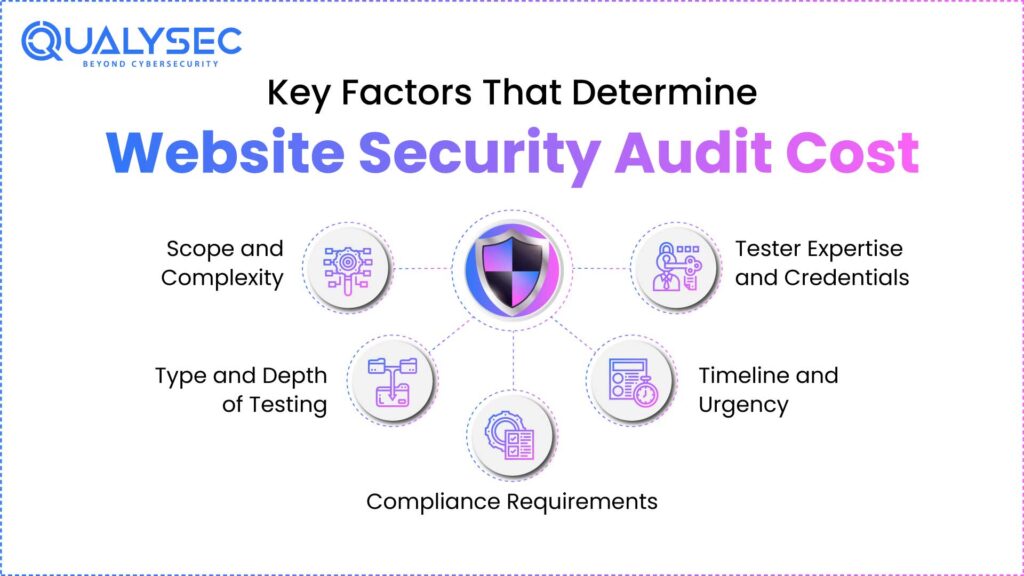
1. Scope and Complexity
The number of unique pages or templates is a critical factor. For example, a 12-page brochure site can be tested in days with a website vulnerability assessment cost at a budget-friendly level. But an e-commerce platform with multiple product templates will take weeks. Multiple third-party integrations and role-based permission accounts need time for testing.
2. Type and Depth of Testing
The process you choose has a direct impact on the accuracy and the cost of website security testing. Automated scanning often employs tools to identify known vulnerabilities. It’s fast and budget-friendly but prone to false positives and misses more complex issues. On the other hand, a hybrid blend of manual and automated testing is slower but yields far more accurate results and is thus costly.
3. Compliance Requirements
If your business operates in a regulated sector, the audit needs to map to specific frameworks. That will definitely increase the cost of website security testing. For instance, healthcare will need to comply with HIPAA/ On the other hand, PCI DSS is a must for financial services, while SOC 2 or ISO 27001 certifications are necessary for SaaS or B2B platforms.
4. Timeline and Urgency
If the deadline is tight and reports need to be delivered urgently, the cost of website security testing will go up. The standard delivery time is 2-4 weeks, depending on the scope and complexity. However, urgent deliveries cost more due to resource reallocation and after-hours testing.
5. Tester Expertise and Credentials
Experienced testers with certifications bring refined skillsets and higher detection rates. That expertise obviously comes at a cost. The positive side is that this can mean the difference between catching a serious flaw and leaving it undiscovered.
How to Choose the Right Provider?
Everyone wants to opt for the right provider, but that means looking beyond mere price quotes. You can use the checklist compiled below to evaluate whether that provider is the right choice for you.
Here are some key questions you need to ask:
Scope Breakdown
- Does the quote clearly specify pages, endpoints, and integrations to be tested?
- Is there full transparency on the pen testing process? Is it manual, automated, or a hybrid blend?
Sample Reports
- Will they share a transparent report so you can evaluate everything clearly?
- Does it include clear evidence and actionable remediation steps?
Retesting Policy
- How many retests are included?
- What is the time window for retesting after remediation?
Compliance Experience
- Have they worked in your industry and with your required frameworks?
- Can they produce compliance-ready documentation?
Tester Credentials
- Do testers have the required expertise and certificates?
- Do they have experience with similar projects beforehand?
Timeline and Availability
- Can they meet your project deadlines without compromising quality?
- Is there a clear onboarding process?
Discover vulnerabilities before attackers do with Qualysec! Download our Sample Penetration Testing Report to understand how vulnerabilities are reported and mitigated.























































































0 Comments