






Penetration Testing Execution Standard (PTES) is a structured approach to planning, conducting, and reporting an authorised penetration test. It breaks an assessment down into seven phases: pre-engagement, intelligence gathering, exploitation, post-exploitation, and reporting.
These phases help testing teams define the scope, assess security weaknesses, validate their impact, and present clear remediation steps. PTES provides a consistent testing approach, helping organisations understand how an assessment is conducted and what its findings mean for their security.
This guide describes the 7 phases of PTES, explains the difference between PTES and other testing frameworks, and explains how to use the methodology in an organisation’s security assessment.
What is the Penetration Testing Execution Standard (PTES)?
The Penetration Testing Execution Standard (PTES) is a methodical approach that describes the typical steps involved in the penetration testing process. It was developed by security professionals and is designed to guide the planning, conducting, and reporting of authorised security assessments.
PTES divides the testing process into seven phases, helping security teams establish clear objectives, gather intelligence, identify vulnerabilities, validate security weaknesses and document their findings. It also includes technical guidance that helps testers understand the activities and considerations involved at different stages of an assessment.
Why Penetration Testing Matters More in 2026: Emerging Enterprise Security Risks
The increasing speed of vulnerabilities exploited, the increasing use of AI in the attack arsenal, and the increasing software supply chain risks are all driving the rise in the importance of penetration testing for organisations.
Microsoft’s 2026 Digital Defense Report found that nearly 40,000 CVEs were published during the first half of 2026. The median time between a vulnerability being discovered in the wild and its weaponisation had fallen below 24 hours, while enterprises could take 30 to 60 days to remediate critical external vulnerabilities.
AI is also changing how attackers target enterprise environments. Google Threat Intelligence reported a Q2 2026 incident in which attackers used agent-enabled automation to execute a mass credential-harvesting campaign within six hours of compromising a cloud resource.
These advancements point to a few areas that organisations should consider:
- Exposed applications and APIs: Identify exposed applications and APIs, broken access controls, and exploitable application flaws.
- Cloud and identity security: Identify vulnerable services, over-privileged identities, breached credentials, and insecure settings.
- Software supply chain: Security of third-party dependencies, source code repositories, and CI/CD pipelines.
- AI-integrated applications: Review access controls, exposure to sensitive data, prompt injection, and risks associated with connected AI applications and agents.
A structured penetration testing methodology such as PTES helps organisations plan authorised assessments, validate security weaknesses, and understand their potential business impact. Regular testing, combined with timely remediation and retesting, helps reduce exposure as threats evolve.
How PTES Differs from Other Standards
Although PTES is perhaps the best-known penetration testing methodology available, it is not the only methodology. Standardised methods of penetration testing also exist, notably the OWASP, the NIST SP 800-115, the OSSTMM, and the ISSAF. Its key distinctive feature is that PTES is not as specialized as some alternatives; it aims to find the balance between the technical details and high-level clarity.
Here’s a side-by-side comparison:
| Framework | Primary focus | Where it is useful |
| PTES | Seven-phase penetration testing methodology | Structuring an end-to-end penetration test |
| OWASP WSTG | Web application and web service security testing | Testing authentication, access control, input validation and application security |
| NIST SP 800-115 | Technical security testing and assessment | Planning tests, analysing results and developing mitigation strategies |
| OSSTMM | Operational security testing | Assessing operational security across relevant areas |
Penetration Testing Execution Standard Process
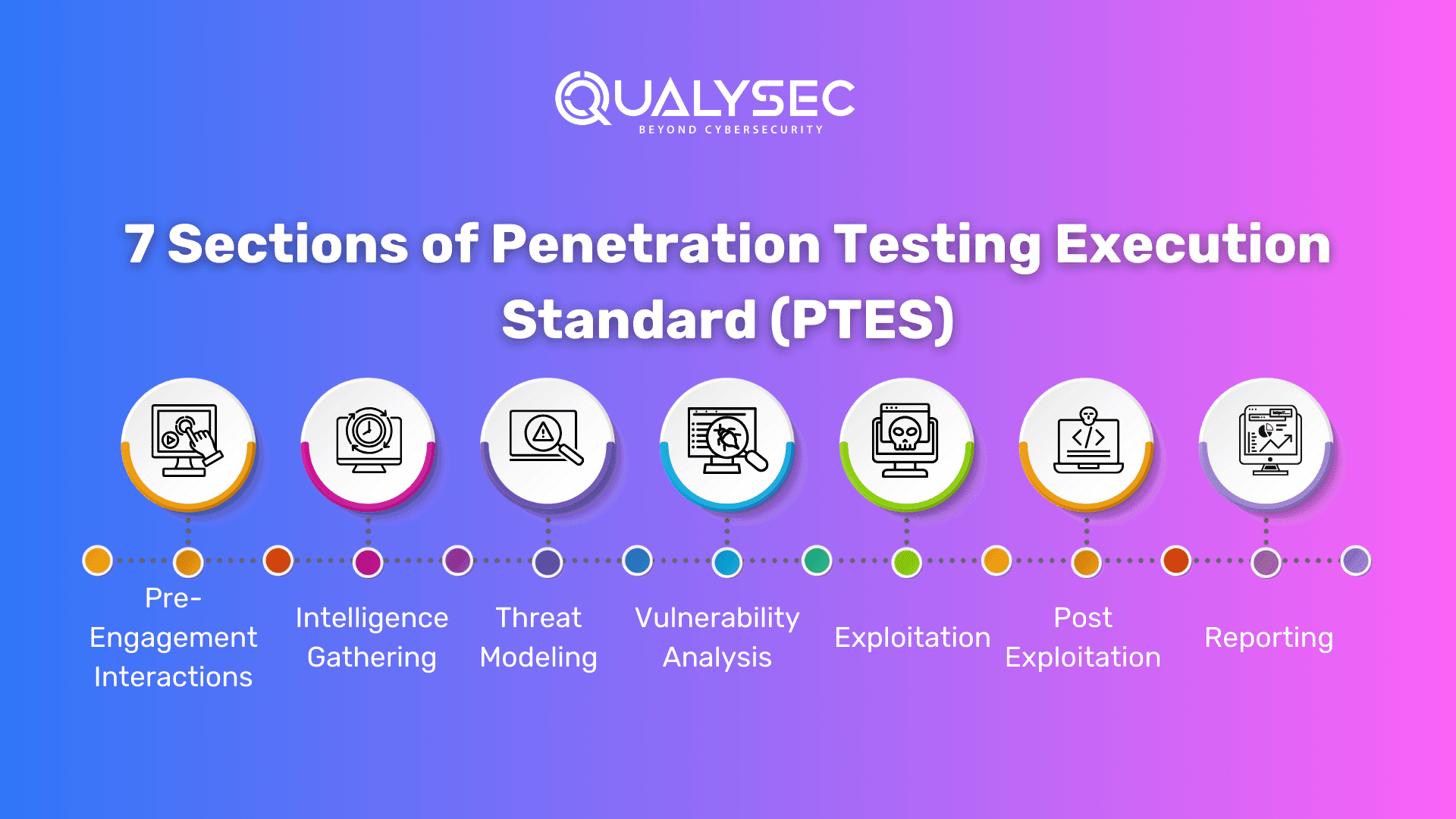
PTES has seven major parts that elaborate on all the facets of the penetration testing process. PTES aims to provide a technical baseline to give organizations a clear understanding of what to expect from a penetration test and take them through the process. The standard does not encompass all the aspects or conditions that may happen on a pen test. Rather, it details only a few regulations describing the essential standard of any pen test.
1. Pre-Engagement Interactions
The first section of the Penetration testing execution standard (PTES) deals with the processes involved before starting the pen test. It includes the interactions between the client or organization and the pen testing team, starting from the final negotiation till the pen testing begins.
The guidelines PTES has set for this section are:
Goals of the Pen Test:
Both the testing team and the client establish specific goals for the pen test. The PTES suggests them to prioritize the following:
- The primary goal of the pen test should be security
- The secondary goal should be compliance and legal accountability
Scope of the Analysis:
After setting clear goals, the pen testing team and the client must agree on the scope and scale of the testing. Here are the elements that need to be considered:
- Identifying the areas to be analyzed
- Deciding on the quality and quantity of the test procedures
- Duration and time of the test
Rules of Engagement:
The testing team and the client should also establish clear expectations and limitations regarding what behaviors are not allowed. This includes:
- Defining particular resources that are “off limits.”
- Setting boundaries for social engineering scams
Once these pre-engagement meetings are done and goals are set, then the pen testers can start the first stage of the penetration test, i.e. reconnaissance.
2. Intelligence Gathering
During this phase, the pen testers gather information through publicly available sources and perform basic searches following the rules of engagement. This process, also known as open-source intelligence (OSINT), collects all the information that could be useful for the later stages of the testing process.
The intelligence-gathering stage includes three levels of reconnaissance:
- Level 1: This is a minimum level of interest in the compliance requirement and could be automatically performed. It contains only the mandatory data on the minimal security requirements of a company.
- Level 2: This level investigates how the organization complies with best practices and priorities other than compliance.
- Level 3: This is an expert level where the pen testers probe deep into the depths of the organization’s business relationships and the complexities to reach more hidden information.
After gathering the necessary information, the pen testing team will then begin planning potential targets for attack.
3. Threat Modeling
After gathering intelligence and understanding the target’s security measures, the next section in the penetration testing execution standard (PTES) is threat modeling. This involves identifying which assets are most likely to be targeted by ethical hackers and what resources might be used to attack them. The pen testers use all the information that has been gathered to plan the attack.
The PTES has outlined a distinct 4-step process for threat modeling:
- Gathering Documentation: The gathering of appropriate documentation and information on the target’s assets and resources.
- Categorizing Assets: Identifying the primary and secondary assets most important or in danger.
- Categorizing Threats: Figuring out the primary and secondary threats which are harmful to the assets.
- Mapping Threat Communities: Associating threats with those assets they attack and who or which organisations may conduct attacks.
- Having defined what can be used, and where possible weak points may lie, this section prepares to move onto phase two, which is to analyse how to exploit the threats.
By identifying valuable assets and potential vulnerabilities, this section lays the foundation for the next phase, which involves analyzing how to exploit these threats.
4. Vulnerability Analysis
In the vulnerability analysis section, the pentester gathers more information related to specific flaws or weaknesses in the client’s cybersecurity systems. This section uses the information gathered earlier to identify and prioritize specific vulnerabilities.
There are two main modes of vulnerability analysis:
- Passive: This involves automated or minimal activity by the ethical hacker, such as Metadata analysis or traffic monitoring analysis.
- Active: This requires more extensive in-depth activity by the attacker. For example, scanning port-based networks, application flaw scanning, and attempting directory listing or “brute force”.
By using these methods, the attacker creates a targeted list of vulnerabilities to focus on during the attack. At this point, ethical hackers often use tools like Vulnerability Scanner Software featured in Spotsaas to automate checks for outdated software, open ports, misconfigurations, and known exploits.
This marks the end of the planning stages, and the ethical hacker is now ready to begin the attack itself.
Aligning Vulnerability Analysis with OWASP Top 10:2025
In vulnerability analysis, penetration testers can refer to well-established security tools like the OWASP Top 10:2025 to assess typical application security vulnerabilities.
Broken access control, security misconfiguration, software supply chain failures, authentication failures, and software or data integrity issues should be emphasized. These areas assist testers to find vulnerabilities that may impact application security, access by users and/or the underlying infrastructure.
The OWASP Top 10 can be used to aid in planning the tests, but the scope and techniques used during the actual testing should be determined based on the architecture and risk profile of the application.
5. Exploitation
All the preparation done in the previous sections leads to the exploitation phase, which is considered the most important step of penetration testing. This is because it is where the actual attack takes place. The attacker or pen tester will use all the information available to carry out targeted attacks. These attacks may vary depending on the goals outlined in the pre-engagement interactions.
However, there are some general principles set by the penetration testing execution standard (PTES) to guide the attacker:
- Stealth: They aim to avoid detection by security systems.
- Speed: They move quickly to infiltrate the client’s systems.
- Depth: They delve deeply into the systems to find vulnerabilities.
- Breadth: They explore as many paths of attack as possible.
The goal of the attacker is to remain undetected for as long as possible, possibly throughout the entire offensive practice. By following these principles, the pen tester will find maximum weaknesses and get maximum insights into the client’s security system.
6. Post Exploitation
In the post-exploitation phase, the hacker shifts to a different type of attack after gaining and exploring the full control of any seized systems. This step is vital in some pen tests, especially those focused on internal analysis.
During this phase, the hacker’s goals depend on the agreed scope with the client. However, the main objectives typically involve:
- Identifying the value and functions of compromised resources.
- Creating additional vulnerabilities for potential future exploitation.
- Maintaining ongoing control over the compromised resources.
- Exiting without being detected.
Both parties need to have clear expectations for this stage. If the exploitation reveals deeper weaknesses that the client didn’t see previously, it can lead to changes in scope and potential conflicts.
However, if the initial discussions were thorough, this stage sets the stage for the final step: reporting.
7. Reporting
The final section, reporting, is a straightforward process if the earlier stages have been completed properly.
The client documents all the steps taken during planning and attacking, and this information is compiled into a report. The report includes:
- Assessment of security posture and ranking of risks.
- Breakdown of the risks discovered.
- Detailed plan for fixing any issues.
Once the report is complete, the pen test concludes. This is where the PTES guidelines come to an end.
The penetration testing execution standard (PTES) outlines seven phases: pre-engagement, intelligence gathering, threat modeling, vulnerability analysis, exploitation, post-exploitation, and reporting.