








That has never been truer than in 2026, when cybercrime is an even bigger problem. Every day, hackers are breaking into companies left and right. They have motives for data theft, service disruption, or loss of business reputation. This translates to one thing: businesses ought to be prepared at any time. VAPT and VAPT Pricing help you understand whether your systems are safe or not.
A penetration test is like a health check for all of your computers, applications, and networks. It locates vulnerabilities and then tests them to see if hackers can exploit the weakness to breach it. Learn how much VAPT costs, the VAPT certification cost, and much more in this blog.
But here is the real question is “How Much does VAPT cost in 2026?”
The cost of cybersecurity penetration testing varies depending on your business size, the type of testing you select, and which penetration testing pricing model you choose. Here is a list of options explained in very layman’s terms so that you can choose the one that suits you and your business better.
What Is VAPT?
VAPT has two parts:
- Vulnerability Assessment (VA) — This is like a scan for any problems with your system, such as open doors or weak locks.
- Penetration Testing (PT) – A perfectly safe attack conceptualized and conducted by a team of experts to determine if those vulnerabilities could indeed be exploited.
VAPT can be:
- Automated: The test is run by a machine. Faster and cheaper, but it may uncover different tricky/mysterious problems.
- Manual- Carefully moderated by humans. It takes forever and costs more, but it finds bigger issues.
- Hybrid — A combination of the two: speed and depth.
Below are the different VAPT services you can avail.
Please note that the price of VAPT varies by the type of security audit that an organization is subjected to. There are a few popular categories under which VAPT services in modern organizations fall.
- Method of VAPT service: Method: – In what method are they providing the VAPT services? Further, this can be distributed into three parts: Black box testing, White box testing, and Grey box testing.
- VAPT Methodology: In this type, it is assessed in various forms due to the types of testing done. VAPT specialists help to find and eliminate bugs in the IT security of an organization. Based on the vulnerabilities discovered, appropriate strategies are implemented by the organization to fill the gaps.
Explore: Vulnerability Assessment vs Penetration Testing: Difference?
Why VAPT Matters in 2026
Cybercrime is not slowing down. According to estimates from Cybersecurity Ventures, cybercrime will cost the world US$10.8 trillion per year by 2026.
One data breach can:
- Make customers lose trust
- Cause legal trouble
- Cost millions to fix
It helps you to find problems before the hackers do. Like locking the doors ahead of a thief arriving.
What Affects the VAPT Cost?
VAPT 2026 Price Pivot Points
- Types of Tests – Number of websites, apps, or networks you want to test
- Type of Testing – Manual is costlier than automatic
- Altering the Depth of Testing – A light scan is cheaper than a deep test.
- Rules You Have to Play By – There are also some industries that have safety rules (PCI DSS or HIPAA), which complicate things.
- Frequency – Doing testing once a year, as opposed to doing it every month, costs less.
- Where the Testers Are – per country price variations.
- Tester Expertise – The more skillful the tester, the higher rate they can command, but often able to uncover more issues.
Table 1 – Estimated Global VAPT Cost in 2026 by Company Size
| Company Size | Basic Automated VAPT | Manual VAPT (Advanced) | Hybrid VAPT |
|---|---|---|---|
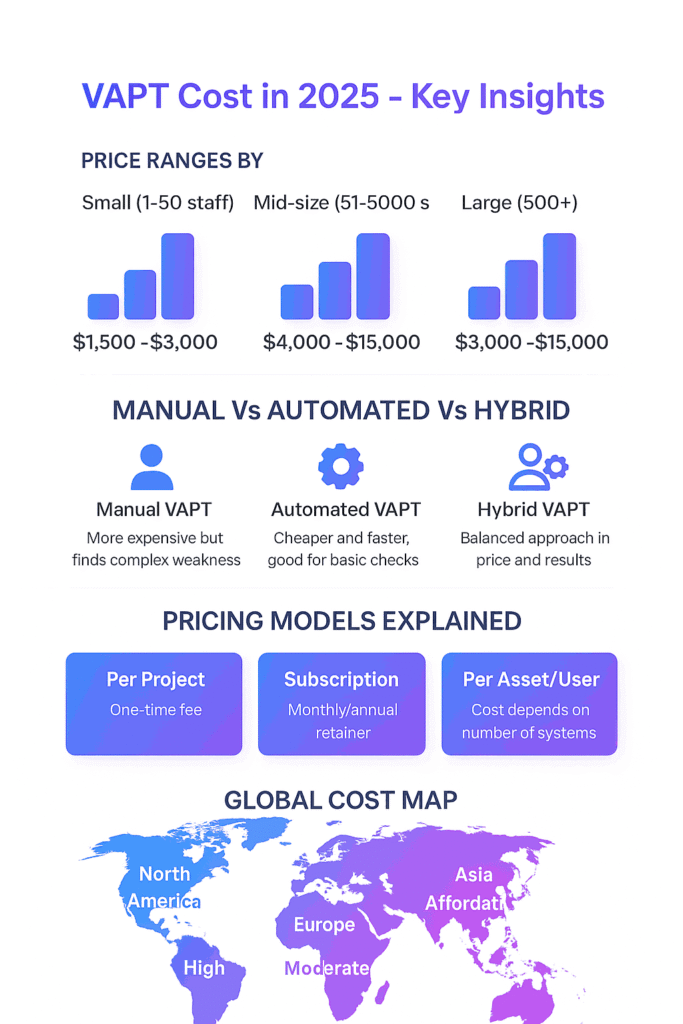
| Small (1–50 staff) | $1,500 – $3,000 | $4,000 – $7,000 | $3,000 – $5,000 |
| Mid-size (51–500) | $3,500 – $7,000 | $8,000 – $15,000 | $5,500 – $10,000 |
| Large (500+) | $8,000 – $15,000 | $18,000 – $35,000+ | $12,000 – $20,000 |
Manual vs Automated VAPT Cost
Manual and automated testing have different prices.
- Automated VAPT – Cheaper and faster, good for basic checks.
- Manual VAPT – More expensive but finds complex weaknesses.
- Hybrid VAPT – Balanced approach in price and results.
How Is VAPT Pricing Structured?
There are three main penetration testing pricing models in 2026:
- Hourly Rate – You pay for each hour the tester works.
- Per Asset – You pay for each website, app, or system tested.
- Fixed Price – One set price for the whole project.
Table 2 – Example VAPT Pricing Models
| Pricing Model | How It Works | Typical Range (2026) | Best For |
|---|---|---|---|
| Hourly Rate | Pay testers for each hour of work | $100 – $300/hour | Small or flexible projects |
| Per Asset | Pay per website, app, or system tested | $500 – $5,000 per asset | Known list of assets |
| Fixed Price | One price for the full project | $3,000 – $20,000+ | Predictable budgets |
What Is the Average Cost for a Mid-Sized Company?
A mid-sized business with 51–500 employees will likely pay:
- Automated: $3,500 – $7,000
- Manual: $8,000 – $15,000
- Hybrid: $5,500 – $10,000
Does a Higher Price Always Mean Better Quality?
Not always. High prices may mean experienced testers, but quality comes from skill, not just cost. Always check:
- Tester’s certifications
- Industry experience
- Past client reviews
- Quality of reports
Global VAPT Cost Trends in 2026
Prices vary across the world. North America is usually the most expensive, while Asia-Pacific often offers lower rates. The difference is often due to wages and living costs in each region.
Some companies hire testers from other countries to save money, but you must ensure they follow strong safety rules and sign agreements to protect your data.
“Explore Why Regular VAPT Audits Are Essential for Security“
How QualySec Can Help
Trusted global VAPT solution provider Qualysec Security announced that it is working together with QualySec. The first pure scoping session, considering your systems and risks. This way, you get an equitable offer from the appropriate penetration testing pricing model — Hourly, per asset, or fixed.
This team of experts deals with every kind of VAPT: automated, manual, and hybrid. Baseline Security, Cybersecurity: Their certified ethical hackers find the holes automated scans often don’t; and because they review every vulnerability individually in plain language, your non-technical managers can determine the full extent of your risk and how to fix it.
Unlike other solutions, QualySec will not just report and go. Closing every security gap by guiding your team to remediation. They will then fix these before re-testing the software again to ensure that none of these issues exist anymore.
It offers suggestions on the security of a transaction taking place in real-time, rules around compliance, and assists an organization in avoiding any risks in the future. They ensure that your business, be it a startup or a worldwide behemoth in the market, is held to safety and trust regulations.
That is where a partner like QualySec would stand by you at every milestone. That is the sort of backing every business will need post-2026.
Why is the Regular VAPT Cheapest in the Long Run
VAPT is a cost, and some companies do not even bother because they can keep it for about a year. This often leads to more spending in the future by skipping or delaying tests.
Here’s why:
For instance, it may be found that fixing a security problem early on during cybersecurity testing of vulnerability assessment will only cost a few hundred dollars. However, if this same issue is not patched, and then a hacker exploits the issue in the future without you ever knowing for weeks to months or longer, that action could end up running into thousands, if not tens of millions.
It is much like car maintenance. Yes, an oil change is a relatively small expense now, but avoiding it can ultimately turn into a major engine repair bill the next time around.
Additionally, even compliance is dictated in a lot of industries. If you miss any of them due to not testing, you may be levied fines. Sometimes, regulators can even go so far as to prevent you from doing business until you take care of the issues.
In addition, regular testing allows Jennifer to better plan. You can also evenly spread your costs and not experience that once in a blue moon billing (when such an emergency occurs) if you schedule VAPT every quarter or twice a year.
All in all, the VAPT pricing in 2026 should ideally be looked at as a security investment rather than an expense. Plot Twist: Testing often saves the day and is a lot cheaper than huge losses or bad publicity. The truth is that any combination of tools, strategies, and software in place does not mitigate the need for continuous monitoring and testing (thanks to many companies out there).
“Our Guide to Choosing the Right VAPT Testing Tools“
Conclusion
No business can skip VAPT in 2026. Many variables can affect the cost, but it will be significantly less than the cost of getting hacked.
So, it pretty much comes down to speed and depth; you choose the testing type — full automated, manual, or a hybrid of both. Select an adequate VAPT pricing model based on your budget.
The Takeaway: Quality is about skill, not price. A good tester will hopefully provide you with straightforward results and tangible solutions.
Ensure that you contact professionals like QualySec to incorporate VAPT as part of your security plan. To protect your data, consider the VAPT certification cost, understand your VAPT testing cost, and schedule regular assessments. This is essential for long-term security and compliance. Contact us for a smart, secure way forward.
FAQs
1. What factors influence the cost of VAPT services?
Scope, type, depth, rules, frequency, location, and tester skill.
2. Is there a difference in cost between manual and automated VAPT?
Yes — manual is more costly but deeper.
3. How is VAPT pricing structured—hourly, per asset, or fixed?
All three exist, each for different needs.
4. What is the average cost of VAPT for a mid-sized company?
Between $5,500 – $10,000 for hybrid testing.
5. Does a higher VAPT price always mean better quality?
No — check skills, reports, and results, not just price.



















































































0 Comments