








The 12 Core PCI DSS Requirements Explained
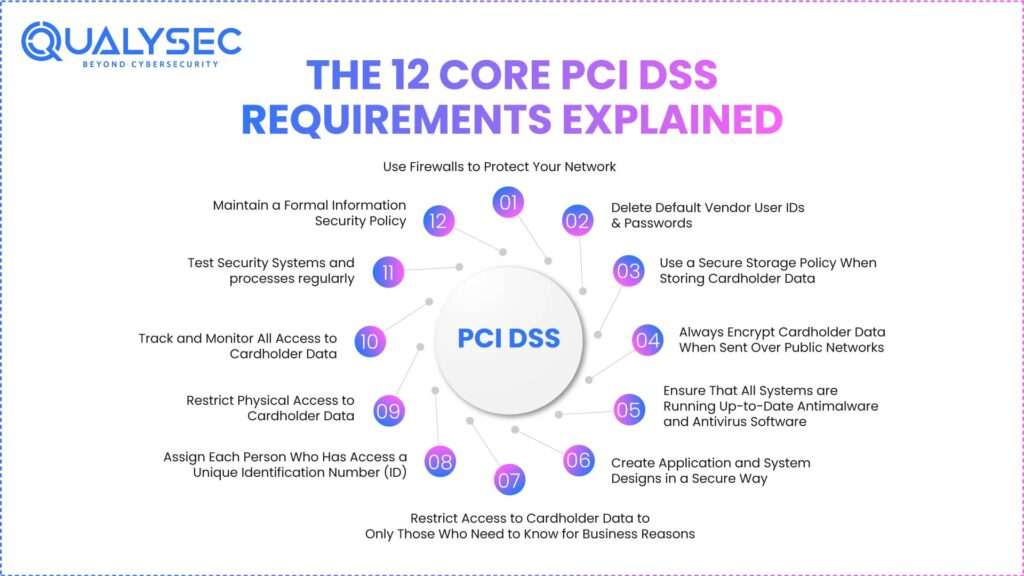
Twelve basic data security requirements are arranged to ensure that cardholder data is end-to-end defined by PCI DSS. Here is a breakdown of the PCI DSS 12 requirements:
1. Use Firewalls to Protect Your Network
A firewall manages traffic that enters and leaves your network and safeguards cardholder data from being accessed by people who do not have permission. Firewalls also create the ability to separate a company’s sensitive areas, so there is a reduced risk of data breaches from within those areas. Read more about Network Firewall Security.
2. Delete Default Vendor User IDs & Passwords
Every business should remove any default vendor-issued user IDs and passwords. Default vendor user IDs and passwords are very easy for people to hack. Removing default vendor user IDs and passwords has been shown to drastically increase the protection of an organisation from automated attacks on a specific group of frequently used user ID/password combinations.
3. Use a Secure Storage Policy When Storing Cardholder Data
Secure Storage Policies (SSP) should specify the acceptable usage of cardholder information in a secure manner and how to use Masking, Truncating, and/or Encrypting cardholder data.
In addition to protecting cardholder information from someone who may gain unauthorised access to the Secure Storage Policies (SSP), the use of Secure Storage Policies (SSP) is an effective way to ensure the ongoing availability and support PCI cloud compliance, ensuring that cardholder data for the organisation.
4. Always Encrypt Cardholder Data When Sent Over Public Networks
An organisation must always encrypt cardholder data when transmitted over the internet or via other public networks. It can use encryption to protect cardholder data from being intercepted or changed by hackers while in transit, which ensures the confidentiality, integrity, and availability of the organisation’s customers’ data.
5. Ensure That All Systems are Running Up-to-Date Antimalware and Antivirus Software
An organisation can reduce the risk of being affected by malware by regularly updating its anti-malware and antivirus software. Every organisation should set up and maintain its antivirus software to allow for constant detection of new and evolving malware threats that try to steal cardholder information.
6. Create Application and System Designs in a Secure Way
Organisations must address any vulnerabilities identified in their Application and System development processes by applying the latest security updates and applying any required security patches. Implementing secure coding best practices and conducting regular application security testing will greatly reduce the organisation’s exposure to exploitation of Application vulnerabilities.
7. Restrict Access to Cardholder Data to Only Those Who Need to Know for Business Reasons
Only those with proper authorisation should have access to cardholder data. Restricting access to only those who need it decreases the risk of an insider threat and enforces that access is granted based on the principle of “least privilege.”
8. Assign Each Person Who Has Access a Unique Identification Number (ID)
By assigning each person a unique ID number, the company establishes accountability for that person, and no one may gain access without proper authorisation. The use of individual IDs also helps create an easily identifiable PCI DSS audit trail, which is useful for both investigation purposes and PCI DSS compliance reviews.
9. Restrict Physical Access to Cardholder Data
Physically secure data centres/office systems that process cardholder information, point of sale (POS) devices, and servers. By securing physical environments, the risk of theft, manipulation, or unauthorised tampering of your device is reduced.
10. Track and Monitor All Access to Cardholder Data
To protect cardholder information, companies must have a record of all access to systems where cardholder information is processed. Tracking and monitoring help to identify any anomalies or suspicious activity as soon as it occurs.
11. Test Security Systems and processes regularly
Regular testing includes scanning through PCI, penetration testing, and vulnerability assessments. Testing continually that identifies new threats and vulnerabilities, and can find them before hackers find out about them.
12. Maintain a Formal Information Security Policy
The workers should each have thorough training on the processes written in the security policy, and it should be updated continuously as improvements in processes take place. A strong information security policy outlines the expectations of the organisation and provides long-term assurance of compliance with PCI DSS requirements.
These twelve standards help to build a strong system for cardholder data security.

Understanding PCI DSS Compliance Levels
Based on annual card transaction volume, PCI DSS compliance is broken down into four tiers:
1st Level
- More than six million transactions every year
- Demands periodic audits by a Qualified Security Assessor (QSA)
2nd Level
- One million to six million sales
- Demands a yearly Self-Assessment Questionnaire (SAQ)
3rd Level
- 1 million e-commerce transactions from 20,000
- SAQ and quarterly PCI scans are required.
4th Level
- Up to 1 million total transactions or fewer than 20,000 in e-commerce
- Simple SAQ including exterior vulnerability scans
- Large corporations run at Level 1; most British small businesses fall under Levels 3 and 4.
Reduce compliance risk by validating PCI DSS 6.4.3 & 11.6.1 with ongoing vulnerability and security control testing.
Key Steps to Achieve PCI DSS Compliance
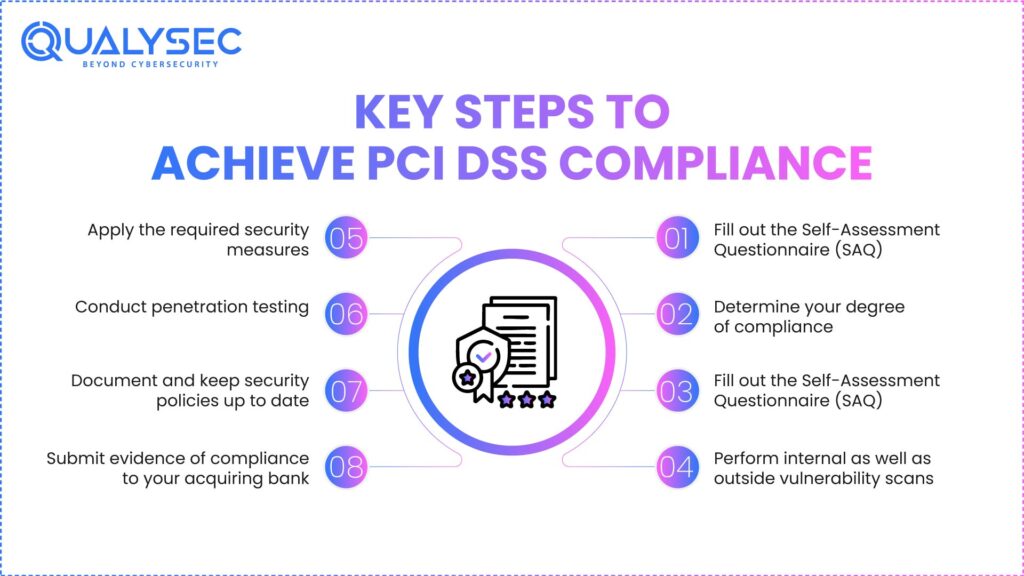
Below are the key steps to achieve PCI Data Security Compliance Requirements:
1. Find cardholder information flow
Map the pathways card data enters, traverses across, and leaves your systems. This aids in deciding which PCI-scoped systems need safeguarding.
2. Determine your degree of compliance
According to the business category and annual revenues. Knowing your level guarantees that you adhere to the right validation and reporting rules.
3. Fill out the Self-Assessment Questionnaire (SAQ)
Different types are possible depending on how your payment processing operates. Selecting the proper SAQ assesses your security controls’ adherence to PCI standards.
4. Perform internal as well as outside vulnerability scans
High-risk security vulnerabilities are discovered by a PCI scan. Quarterly surveys enable ongoing awareness of flaws throughout your surroundings.
5. Apply the required security measures
Among other things: encryption, safe network installation, access regulations, and monitoring. Applying these measures enhances your company’s resistance against data breaches.
6. Conduct penetration testing
Several sorts of SAQs demand confirmation of vulnerability exposure in the actual world. PCI DSS Pen tests confirm if hackers are able to bypass protections and abuse system flaws.
7. Document and keep security policies up to date
Included employee training and incident response approach. Strong documentation helps long-term compliance and guarantees employees understand their duties.
8. Submit evidence of compliance to your acquiring bank
Once verified, you receive PCI compliance certification. This last step confirms that your company is following all PCI DSS criteria.
Download a sample report to understand how our security testing supports PCI Data Security compliance Requirements and risk reduction.


























































































































































0 Comments