




Qualysec

BLOG

What Is Data Protection As A Service (DPAAS)? Strengthening Cloud & Endpoint Security

Chandan Kumar Sahoo

Chandan Kumar Sahoo

Published On: December 23, 2025

chandan

Chandan Kumar Sahoo

August 29, 2024

What Is Data Protection As A Service (DPAAS) Strengthening Cloud & Endpoint Security
Table of Contents

In our digital world, organisations are confronted with a growing tsunami of data – in the cloud, spread across remote endpoints, and at constant risk of cyber-attack. As businesses grow, so too does their potential for data loss, ransomware and compliance violations. On-premises backup solutions don’t meet the need, especially when agility, scalability, and security are vital to success. That’s where Data Protection as a Service (DPaaS) emerges: a managed, cloud-native solution that delivers built-in security and operational flexibility. 


By outsourcing your data protection, organisations can pivot their focus away from infrastructure and toward innovation. In this blog, we’ll take a look at what DPaaS is, why it matters, and how to select the right provider in 2026.

What Is Data Protection as a Service (DPaaS)?

Data Protection Service (DPaaS) refers to a model delivered through the cloud that backs up, archives, secures, or recovers data across different environments, such as cloud platforms, on-premises environments, and endpoints. 


Rather than purchasing, installing, and maintaining costly hardware designed for back-ups, organisations purchase a subscription for a DPaaS service to manage organisation-wide data protection in an efficient, scalable manner. DPaaS service typically includes automated backups, data protection using encryption, disaster recovery, and compliance


DPaaS providers’ business is focused on protecting data, allowing them to offer enterprise-level data protection and recovery without the obstacles and costs associated with traditional data protection infrastructure. By 2025, this service will become increasingly important due to regulatory requirements, increased cyber threats, and a vast increase in unstructured data.


You might like to know about Data Security Services in Cybersecurity: Protecting Sensitive Information in the Digital Age.

How Data Protection as a Service (DPaaS) Works

Data Protection as a Service (DPaaS) employs cloud architecture to offer continuous protection across multiple environments (Cloud, Endpoint, On-Premises) using lightweight agents, centralised policies, and automation. 


Lightweight agents are installed on Servers, Endpoints, and Workloads, working alongside endpoint security solutions to monitor and protect data itself while establishing policy-based controls that determine how Backups are created (Frequency, Retention, Encryption, and Compliance).


Automation also minimises the need for Manual Interaction or Human Error during Backup Scheduling and Execution. Therefore, it offers a real-time monitoring and alerting system, providing visibility into Backup Performance and verifying the integrity of the Data throughout the Life Cycle of the Backup Process. In the event of an outage or other catastrophic events, DPaaS offers rapid restoration capabilities or failover to Disaster Recovery Systems, thereby ensuring Business Continuity.


Ready to secure your cloud and endpoint data? Contact us to see how DPaaS can protect your business.

Speak directly with Qualysec’s certified professionals to identify vulnerabilities before attackers do.

Types of Data Protection as a Service (DPaaS) Solutions
Types of Data Protection as a Service (DPaaS) Solutions


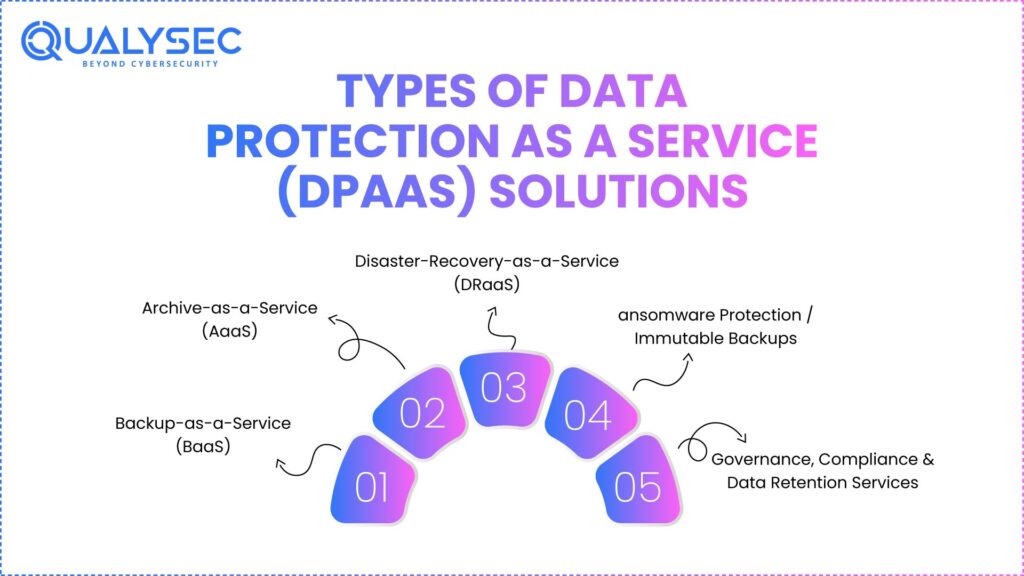
DPaaS is not a uniform service – you can choose from a variety of options based on your needs and risk profile.


These are the primary kinds of Data Security Services in Cybersecurity:

  • Backup-as-a-Service (BaaS): Backup of files, databases, virtual machines, endpoints, etc., in the cloud. 
  • Archive-as-a-Service (AaaS): Storage of infrequently accessed data for a longer period of time, usually for regulatory or compliance purposes.
  • Disaster-Recovery-as-a-Service (DRaaS): Full failover environments or replicas in the cloud that can take over in the event of a total system failure.
  • Ransomware Protection / Immutable Backups: Write-once-read-many storage or snapshots to protect against tampering with regular ransomware testing to confirm data protection.
  • Governance, Compliance & Data Retention Services: DPaaS that’s focused on helping ensure compliance with GDPR, data-residency, reporting, or data retention policies.

Why Organisations Need DPaaS Today

In 2025, many organisations are rethinking data protection — not merely as a backup task but as a strategic cybersecurity imperative.


Here’s why we’re seeing DPaaS become more critical:

  • Increasing Cyber Threats: Ransomware and data breaches continue to be the top threats when it comes to data protection, and DPaaS delivers a stronger, more automated way to recover.
  • Regulatory Pressure: In Europe, the advent of GDPR consultants and other national data-privacy laws, and similar laws in other countries, requires firms to deploy systems that can demonstrate consistent use of robust, auditable data protection. 
  • Explosion of Data: The amount of unstructured data and structured data is growing exponentially, as systems developed over decades use unstructured data and cloud-based protection scales orders of magnitude more effortlessly than old-school systems.
  • The Proliferation of Endpoints: Data now lives on many endpoints due to remote work, IoT, and mobile devices, meaning all of these endpoints must be protected.
  • Cost: Firms can shift risk to the insurance model of cloud, instead of spending tens of thousands of dollars on on-prem hardware, using an OPEX/Subscription model that enables firms to be more cost-effective and flexible.

Understand your security vulnerabilities assessment costs and risk. Contact us for a detailed vulnerability assessment quote today.

See our pricing, then talk with an expert to choose the best solution for your organization.
Dollar Sign

Benefits of Data Protection as a Service (DPaaS)
Benefits of Data Protection as a Service (DPaaS)


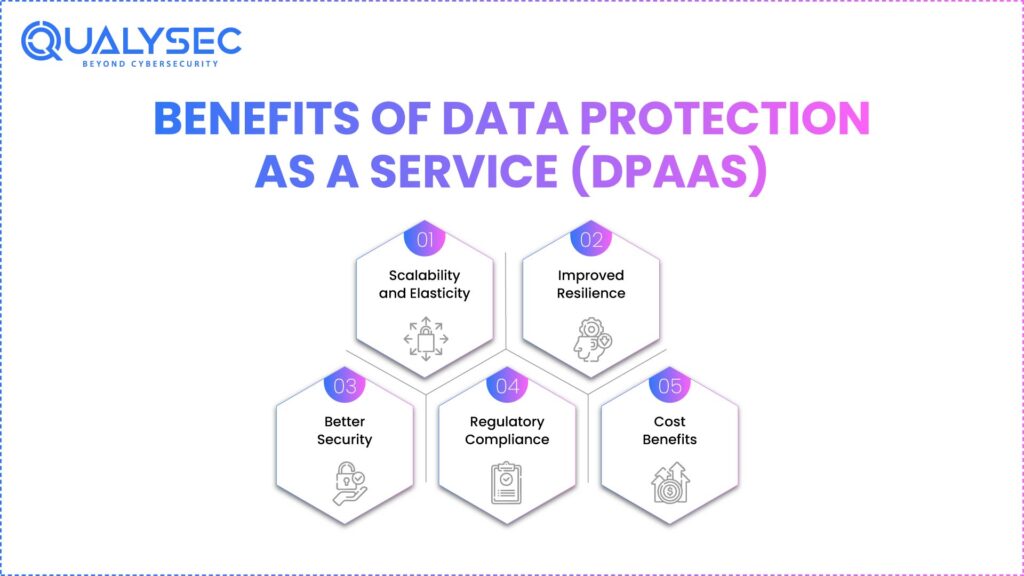
Adopting DPaaS provides several benefits—especially in the context of a contemporary, distributed business environment. 


Here’s what organisations can expect to gain: 

  • Scalability and Elasticity: As data grows, the service scales with it automatically and minimises large upfront investment costs. 
  • Improved Resilience: With immutable backups and a Disaster Recovery option, DPaaS reduces downtime and ensures continuing business functionality. 
  • Better Security: Generally, DPaaS comes with encrypted data, zero-trust models, and continuous monitoring to bolster data protection against loss or attack. 
  • Regulatory Compliance: Built-in compliance audit logs, reporting, and in some cases, data retention support compliance with laws such as GDPR and other regulations in Europe. 
  • Cost Benefits: Experts in the field can provide cost benefits regarding infrastructure, maintenance, and staffing by outsourcing data protection.

How to Choose a DPaaS (Data Protection as a Service) Provider

Assessing the safest way to select a Data Protection as a Service (DPaaS) provider will depend largely on four security assessments: Security Modes, Technology/Service standards, Compliance and Assurance Levels, and Service Delivery Quality. The foundational aspect of any data protection solution is the security component. It is imperative to establish unequivocally that the provider offers comprehensive encryption capabilities, supports immutable storage where appropriate, and follows the principles of zero trust to lessen exposure to both Internal and External Threats.


The compatibility of the cloud provider’s infrastructure with all major cloud platforms ( and on-premise storage solutions is also crucial. The speed of recovery for all organisation applications must be evaluated and considered to create a plan that includes acceptable RTO and RPO thresholds. Cloud data security, including encryption, access control, and monitoring, ensures data stays safe during storage, transfer, and recovery. A comprehensive recovery and failover strategy is also important when determining the speed with which an organisation can resume business activities after an incident.


Another key consideration relates to the importance of compliance. A good DPaaS offering will provide users with data governance tools, audit trails, and regulatory compliance reports to assist them with complying with requirements like GDPR and data residency requirements. Cost transparency also plays an important role. Organisations should understand how to gauge cost by factors such as volume of data stored, number of endpoints accessing data, and volume of features included with a particular DPaaS service. 


Finally, organisations should conduct a thorough review of the Service Level Agreements provided by the Provider, along with the quality of customer support provided by the Provider, to ensure that users can expect reliable uptime, long-term data durability, and responsive technology assistance.


See how Data Protection as a Service helps organizations secure data and ensure continuity. Read our case studies.

Conclusion

In conclusion, Data Protection as a Service (DPaaS) is quickly becoming a vital aspect of today’s business continuity and cybersecurity framework. By leveraging a cloud native managed service to handle backup, disaster recovery, and compliance, organisations are achieving better data protection while avoiding the capital expense associated with conventional infrastructure. 


In Europe, particularly, regulatory frameworks like GDPR — in addition to rising cyber threats — render DPaaS a necessity, rather than a convenience. As we move further into 2025, organisations that leverage DPaaS and robust data security solutions will be positioned to deliver better data security, reduced risk, and continuity regardless of data locality.


Take a look at Qualysec’s ratings and reviews on Clutch to see how we help businesses secure their data. Book a free live consultation to learn more.  
See Why Companies Worldwide Trust Us
Testimonials

FAQ’s

1. What are the primary provisions of the DPDP Act? 

The Digital Personal Data Protection (DPDP) Act emphasises safeguarding the personal data of individuals, while making it mandatory for organisations to manage data responsibly. The DPDP defines lawful data processing, specifies what organisations must do when obtaining user consent, and provides stringent expectations for data fiduciaries. The DPDP Act also identifies cross-border data transfer provisions, penalties and punishments for non-compliance, and provides data subjects with strong rights protections.

2. What does DaaS refer to? 

Data as a Service (DaaS) involves the on-demand delivery of data through a cloud-based service. Organisations do not store data or manage it directly; instead, they access preferred data streams or datasets through the internet. DaaS will reduce organisation data storage costs and allow for faster decisions with real-time data delivery.

3. What is the SaaS data protection policy? 

A SaaS data protection policy is a set of rules and guidelines that keeps customer data secure, which is stored in Software as a Service applications. SaaS data protection policies typically include encryption, access controls, data retention and backup processes, as well as compliance with privacy requirements. Providers operationalise SaaS data protection policies to prevent data breaches, data loss, or unauthorised access.

4. What is Data Protection as a Service?

Data Protection as a Service (DPaaS) is a cloud-based service that provides data protection services to enterprises for backup, recovery, archiving, and security of enterprise data. It protects workloads in the cloud, on-premise systems, and endpoints, through fully automated and scalable services. DPaaS provides organisations with stronger resilience, reduced costs, and enables them to meet compliance without having to administer, manage, and support complex infrastructure.
Qualysec Pentest is built by the team of experts that helped secure Mircosoft, Adobe, Facebook, and Buffer

Chandan Kumar Sahoo

Chandan Kumar Sahoo

CEO and Founder

Chandan is the driving force behind Qualysec, bringing over 8 years of hands-on experience in the cybersecurity field to the table. As the founder and CEO of Qualysec, Chandan has steered our company to become a leader in penetration testing. His keen eye for quality and his innovative approach have set us apart in a competitive industry. Chandan's vision goes beyond just running a successful business - he's on a mission to put Qualysec, and India, on the global cybersecurity map.
Leave a Reply

Your email address will not be published.

Save my name, email, and website in this browser for the next time I comment.

0 Comments

No comments yet.

Chandan Kumar Sahoo

CEO and Founder

Chandan is the driving force behind Qualysec, bringing over 8 years of hands-on experience in the cybersecurity field to the table. As the founder and CEO of Qualysec, Chandan has steered our company to become a leader in penetration testing. His keen eye for quality and his innovative approach have set us apart in a competitive industry. Chandan's vision goes beyond just running a successful business - he's on a mission to put Qualysec, and India, on the global cybersecurity map.
3 Comments

emurmur

John Smith

Posted on 31st May 2024

Lorem ipsum dolor sit amet, consectetur adipiscing elit. Ut et massa mi. Aliquam in hendrerit urna. Pellentesque sit amet sapien fringilla, mattis ligula consectetur, ultrices mauris. Maecenas vitae mattis tellus. Nullam quis imperdiet augue.

    Pentesting Buying Guide, Perfect pentesting guide

    Subscribe to Newsletter

    Scroll to Top
    Pabitra Kumar Sahoo

    Pabitra Kumar Sahoo

    COO & Cybersecurity Expert

    “By filling out this form, you can take the first step towards securing your business, During the call, we will discuss your specific security needs and whether our services are a good fit for your business”

    Get a quote

    For Free Consultation

    Pabitra Kumar Sahoo

    Pabitra Kumar Sahoo

    COO & Cybersecurity Expert