








Cyber threats are becoming more advanced at an extraordinary rate across all areas, including both quantity and complexity. Malware authors utilize machine learning and AI techniques to evade detection, making it difficult for traditional antivirus systems to detect these types of threats. The advent of AI for malware detection has changed the landscape due to its ability to predict, analyse, and prevent potential attacks before they inflict serious harm. AI utilises intelligent behaviour analysis and sophisticated pattern identification to allow security systems to detect previously known and new malware as it occurs in real time.
As bad actors evolve, so too must defenders. AI-driven security systems provide defenders with the opportunity to keep pace with evolving threats.
Why Traditional Malware Detection Is No Longer Enough
Traditional methods of AI for malware detection are primarily based on the identification of specific signatures associated with malicious software. Malware is created in many different ways by modern-day hackers, and most employ the use of polymorphic, metamorphic, and obfuscation techniques to conceal their signature from being flagged when vulnerability scanned against existing definitions.
Because most malware programs actively exploit unknown vulnerabilities (often referred to as ‘zero-day’), when attackers discover them, there will be no matching signature to identify them. The bottom line is that, as a result of having static definitions, security systems create many blind spots where malware can be missed.
The speed of attack today is much faster than can be analysed using manual processes. Therefore, outdated methods of detecting malware based solely on signatures cannot keep up with the pace of evolving malware threats.
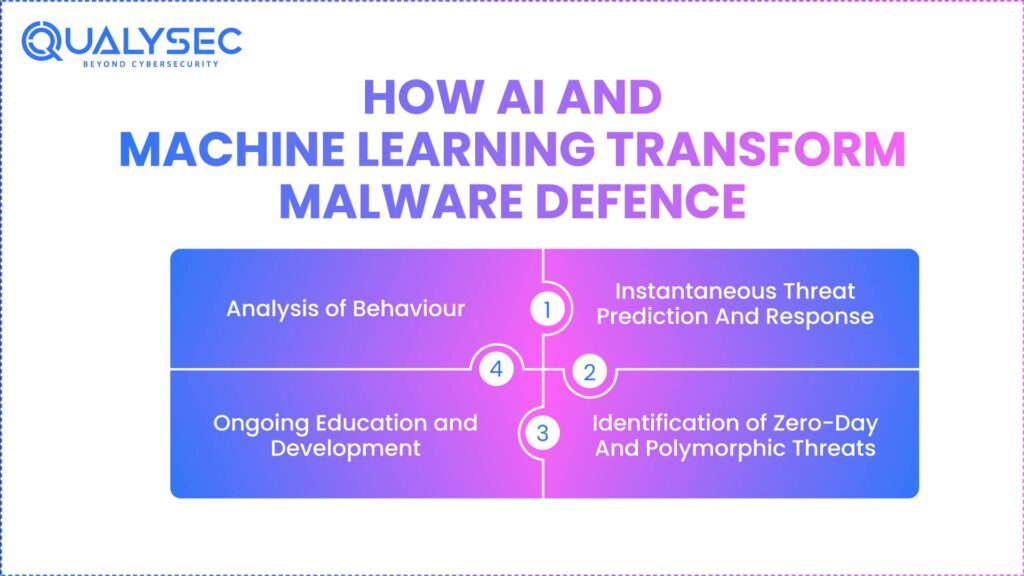
How AI and Machine Learning Transform Malware Defence
The use of AI and machine learning has changed the way that security teams detect and respond to malicious software (also known as “malware”). In AI and machine learning penetration testing, rather than focusing on a single code pattern, as was the case before, many of these systems are now analysing malware by looking for certain types of behaviour, patterns of activity, and anomalies in real time.
In doing so, these systems can identify new or mutated versions of malware because of their ability to learn from large data sets. AI can learn, develop, and adapt as new techniques for attacking computers and networks emerge. This ability continues to add value to AI as a core component of today’s malware prevention systems. Learn about AI network security.
1. Analysis of Behaviour
Rather than merely checking code signatures, behaviour analysis detects malware based on how the application works. It does this by observing system calls, file behaviour, and network activity to determine whether or not an application’s activity is typical. This enables the detection of malware even if it has been encrypted or obscured in its code. Behavioral analysis provides security teams with a more accurate security assessment of the malware threat.
2. Instantaneous Threat Prediction And Response
Machine learning tools can assess threats and respond immediately and automatically without needing to wait for someone to do it for them. They will automatically block, quarantine, or isolate rogue activity based on their assessment of the activity as high, medium, or low risk based on probability scores. This reduces the time an attacker has to penetrate an organisation’s environment. Instantaneous threat assessment limits the potential impact of threats that are gaining momentum.
3. Identification of Zero-Day And Polymorphic Threats
The plethora of malicious activities that artificial intelligence learns from helps it detect a brand-new attack. Polymorphic malware has an ever-changing signature, but by studying behavioural patterns, artificial intelligence can detect the intent behind the malware. This means that even if the polymorphic malware looks entirely new, the model will still catch it based on its behaviour patterns. This means that zero-day threat detection has an increased reliability factor.
4. Ongoing Education and Development
Through continuous analysis of new threat data and input provided by analysts, AI Models are always able to learn, improve, and grow. Therefore, when cybercriminals adapt in their offensive operations, AI continually updates its ‘version’ of what ‘maliciousness’ resembles, resulting in very high accuracy in the detection of cyber threats over time. As well as ensuring that they remain effective against the next wave of technologically sophisticated cyberthreats.
Download a sample report to know how AI and Machine Learning are revolutionizing malware protection.

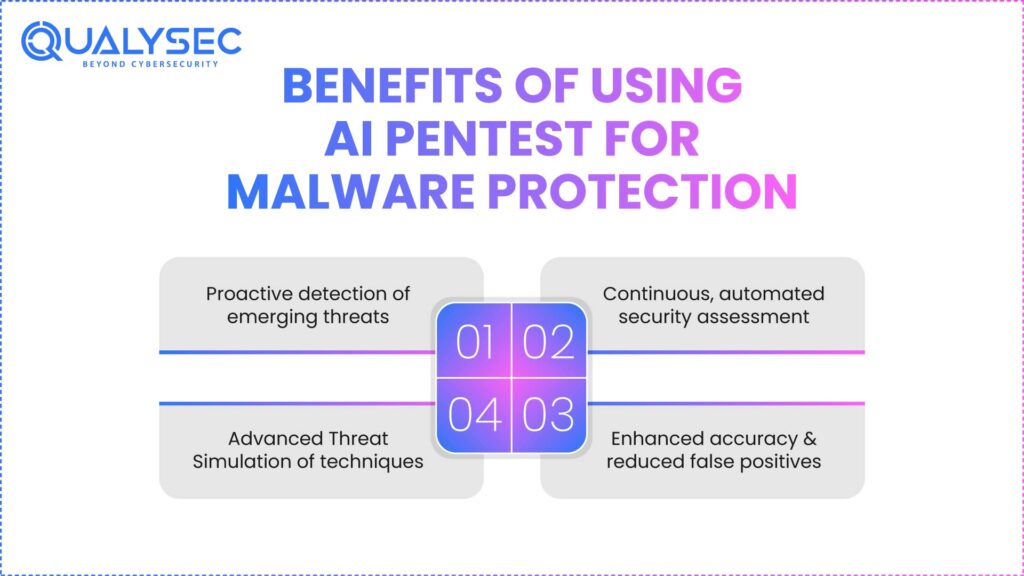
Benefits of Using AI Pentest for Malware Protection
An AI-powered Penetration Testing (AI Pentest) solution improves the ability of an organisation to find malware threats faster and with more accuracy than manual (human-based) testing. AI Pentest continuously learns threat patterns and creates a simulation of possible future attacks as a form of artificial intelligence (AI).
By using these capabilities, organisations can ensure that security teams have the means to proactively strengthen their defences. Providing faster detection times, reducing workloads on analysts, and enabling deeper penetration into unknown vulnerabilities throughout an organisation’s digital assets achieves this.
Proactive detection of emerging threats:
The AI Pentest identifies emerging threats based upon previously unidentified behaviours of malware by analysing massive amounts of data in real-time. By using this capability, AI cybersecurity can analyse all known types of malware based on several different Code Anomalies and Traffic Deviations.
The AI-Driven Pentesting technology provides time to react prior to the threat becoming critical. This capability gives organisations a more robust defence against fast-paced attacks.
Continuous, automated security assessment:
Unlike more traditional Penetration Testing, which testers perform periodically, AI Pentesting operates 24 hours a day and continually scans a network for security holes that new devices, application installations, configuration changes, and Shadow App installations may create.
AI helps to reduce reliance on a Human Schedule and allows no lapses in security coverage for the entire time. This continued validation of the effectiveness of security controls improves an organisation’s ability to stay Ready for Malicious Attacks and to significantly reduce its exposure periods.
In addition, AI secures computer-assisted automation seamlessly in larger Hybrid Organisations where multiple Cloud Providers are supported. Read about AI Cloud Security.
Enhanced accuracy and reduced false positives:
By utilising historical threat activity and analyst feedback to evolve detection rules, Machine Learning models will improve the level of accuracy and decrease the number of false positives generated by the alerts sent to Security Operations Centre (SOC) teams.
This will result in fewer alert events, allowing Security Analysts to concentrate on analysing alerts that represent an actual threat. Organisations develop an efficient and accurate detection system over a period of time. They will have the ability to use their Security Analysts’ time efficiently by eliminating redundant, non-threat alerts.
Advanced Threat Simulation of techniques:
The use of AI pentesting tools can simulate various sophisticated, advanced attacker techniques, such as polymorphic malware, lateral movement, and attempts to exploit zero-day vulnerabilities.
By using these simulations, researchers can test malware to determine whether it can bypass different layers of defence, using the same techniques as in a real-world environment. By utilising the intelligence learned from these attacks, engineers will have the ability to create patches before the implementation of an advanced attack technique.
Organisations that utilise these simulations will be in a better position to respond to advanced criminal threats and will have the advantage of understanding and analysing the methods employed by their adversaries.
Explore how our AI-Powered security services have delivered measurable results for businesses – Read Client Testimonials.


Best Practices for Implementing AI Malware Defence
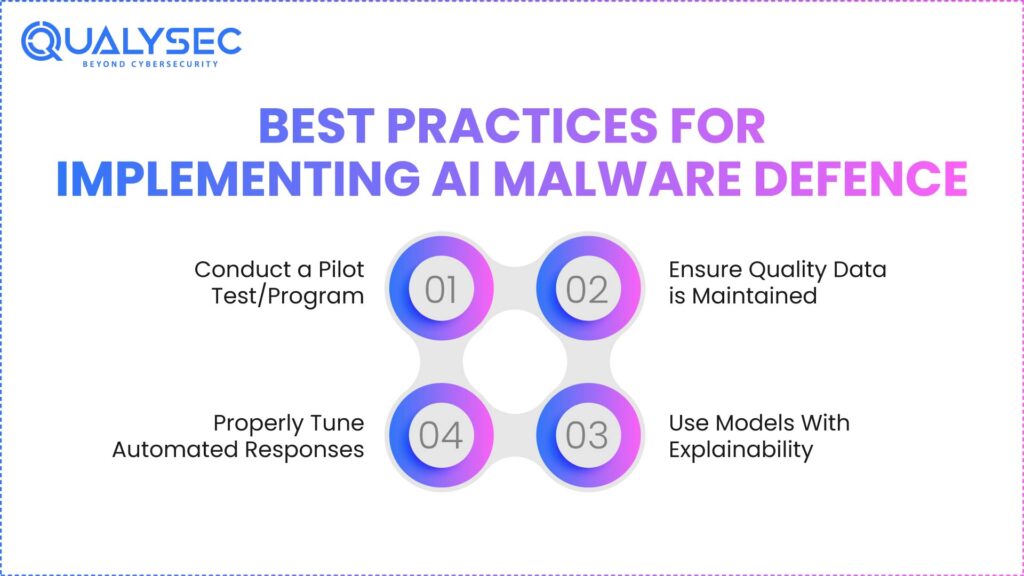
Organisations should develop a sound plan for AI-based malware detection implementation, with due diligence on data quality and oversight. Proper integration into existing technology is critical for the best results from an AI security solution, as is training your employees to accurately interpret insights and validate actions made as a result of AI technology.
Utilising best practice methodologies will increase the accuracy and longevity of your investment in security using AI, ultimately allowing you to receive maximum value from an AI investment.
1. Conduct a Pilot Test/Program
Before implementing AI technologies, organisations should conduct pilot programs in a controlled setting. This allows for identifying any strengths, weaknesses, or issues related to the deployment of AI, as well as validating detection accuracy. Early pilot testing will allow for smoother overall deployment.
2. Ensure Quality Data is Maintained
Quality data ensures that models are trained properly and reduces false positives. The organisation must maintain an updated and accurate threat intelligence feed, with the inclusion of diverse attack sample types. Quality data is the foundation upon which any AI security model and AI security testing will be built.
3. Use Models With Explainability
Tools with clear processes make it easier for analysts to trust your system, as well as support compliance and auditing. Explainable AI also supports more informed decision-making, reduces confusion, and makes it easier to respond effectively.
4. Properly Tune Automated Responses
Automation is supposed to help humans make better-informed decisions, not replace their judgment. Therefore, organisations should set guidelines for automated responses that include the severity of incidents. Organisations will still need human input before performing critical actions and thus need to use the proper tuning of their automated response process to minimise workflow disruptions.
Learn the latest cybersecurity best practices to protect your business today.
How Penetration Testing Enhances AI Malware Protection
Penetration testing services enhance the security of AI by identifying vulnerabilities while simultaneously providing organisations with high-quality data to train their models. Pentesters perform simulated attacks that reflect types of large-scale or targeted cyberattacks that real threat actors could perform.
By using penetration testing to train AI systems, organisations have access to information to ensure that their security models are functioning as intended. It can also identify any potential weaknesses and develop strategies to strengthen them. When combined, penetration testing and artificial intelligence create an effective and dynamic security paradigm for organisations.
1. Simulating Actual Attack Scenarios
The process of pentesting mimics how even the most sophisticated attackers actually attack (advanced threat techniques) to see if an AI system can detect them. Additionally, this simulation process exposes any “blind” areas of an AI detection model and assesses how the AI will respond to incidents of high intensity (pressure). All of this together results in increased overall protection against advanced techniques.
2. Generating Very Valuable Training Data
Pentesting produces valuable (as opposed to waste-of-space) labelled data for the AI to utilise when training. Examples of what this includes are: instructions (or messages) sent by the operating system to other parts, memory activity, and characteristics of a defined behaviour. The more realistic the data is when training, the more accurate the pentesting AI will be when detecting new types of threats.
3. Verifying Incident Response
The organisation that conducts pentesting can evaluate the accuracy of the automated responses it creates during tests. This helps ensure that the processes used for containment trigger correctly and identify weaknesses where the response must be monitored by personnel. By verifying incident response processes, an organisation’s readiness for adverse events (attacks on its organisation) will be stronger.
4. Enhancing Model Accuracy Over Time
Pentest Results inform model updates. This provides an ongoing feedback loop to increase detections. With every cycle, the resiliency of the system increases. As such, there is a significant improvement in overall long-term accuracy.
Explore AI for Cyber Attack Prevention. It Stop Threats Before They Happen.
Conclusion
AI for malware detection is the intelligent, nimble, and versatile means of stopping modern-day threats using behaviour and pattern recognition to find attacks that were not detected by traditional methods. AI detection, as part of artificial intelligence in cybersecurity, allows for a reduction in response times, increases accuracy, and encourages ongoing training to detect new threats.
Although there are some obstacles to overcome with AI detection, these can be addressed by being organised and following a procedure. The development of complex cyber threats is an ongoing process. Thus, the adoption of AI-based defence systems will give the ability to secure systems today, while supporting the ability to secure systems tomorrow as cyber threats evolve.
Partner with Qualysec to explore practical approaches for improving cybersecurity and AI integration.



























































































































































































































































































































0 Comments