








One little application vulnerability can quietly expose tens of thousands of users, interrupt daily activities, and cause legal problems. Application breaches are now not uncommon occurrences in India, where digital platforms enable banking, fintech, healthcare, and governmental services. The expense and effect of security failures keep rising as applications become more intricate. Here, interactive application security testing enters as a wiser method. I AST notes how an application behaves while it is actually operating, rather than examining static code alone or scanning without knowledge from the outside. It shows actual data flow, actual execution pathways, and real security vulnerabilities.
This manual will help you to know what Interactive Application Security Testing (IAST) is, how IAST testing operates, why businesses in India are quickly embracing IAST security, and how it fits into modern application security testing tactics.
What Is Interactive Application Security Testing (IAST)?
A modern application security testing method, interactive application security testing (IAST), examines applications from within while they are operating. As tests or regular traffic pass over the system, it uses lightweight agents set within the application to monitor code execution, data flow, API calls, and runtime behavior.
Unlike conventional vulnerability scanning solutions based on signatures or hypotheses, IAST only exposes weaknesses when they are actually implemented. This lets IAST security testing find actual, exploitable vulnerabilities rather than theoretical dangers that could never be encountered in production.
Its hybrid nature makes interactive application security testing so effective:
- Code-level visibility, like SAST, helps teams identify precisely the weak code line.
- Runtime behavior analysis, like DAST, which guarantees vulnerabilities are verified throughout execution
- Context-aware detection reveals how user input passes across the program.
This equilibrium has led many security departments to view IAST solutions as the main cornerstone of safe software development.
Qualysec combines interactive application security testing with expert penetration testing for deeper coverage. Learn more!
How Does IAST Operate?
Directly placing a security agent into the application during testing or staging phases defines IAST. While functional tests, automated test cases, or manual traffic engage with it, this agent quietly observes events within the application.
The process works in reality as follows:
1. The IAST agency instrumented the application code.
Without changing application logic, the agent links to the runtime environment and watches method calls, data inputs, and outputs.
2. Traffic testing causes genuine application behavior.
The application acts exactly as it would in production while QA tests or user simulations are run.
3. The agent follows APIs, libraries, sinks, and data flow.
It shows how unreliable data travels through APIs, databases, and backend components.
4. Detecting vulnerabilities with a complete execution context.
Issues are found only when hazardous behavior actually takes place.
5. Developers get thorough results created for them.
Reports have stack traces, weak code paths, and repair advice.
Since IAST testing happens within the application, it helps one to understand not just what is susceptible but also why the vulnerability exists and how it might be used. This makes security IAST far more realistic than many conventional application security testing systems.
Explore our Web Application Security Testing services to identify vulnerabilities and protect your applications.
Reasons IAST Counts In Modern Application Security
APIs, microservices, containers, cloud infrastructure, and third-party libraries are used in modern applications. Because many weaknesses only manifest during runtime interactions, this layered design complicates security testing.
By watching actual execution rather than guessing, interactive security testing helps to solve this problem. It finds flaws usually overlooked by perimeter scanning or static analysis, especially data-flow and logic-level flaws.
Today’s key justifications for the significance of IAST security testing include:
- Because results depend on real execution, lowering false positives is important.
- Giving real exploit paths instead of theoretical hazards
- Direct vulnerability mapping to source code saves developer time.
- Fast team problem-solving increases release cycles.
For DevSecOps teams trying to send swiftly, IAST security allows quicker releases without compromising application safety.
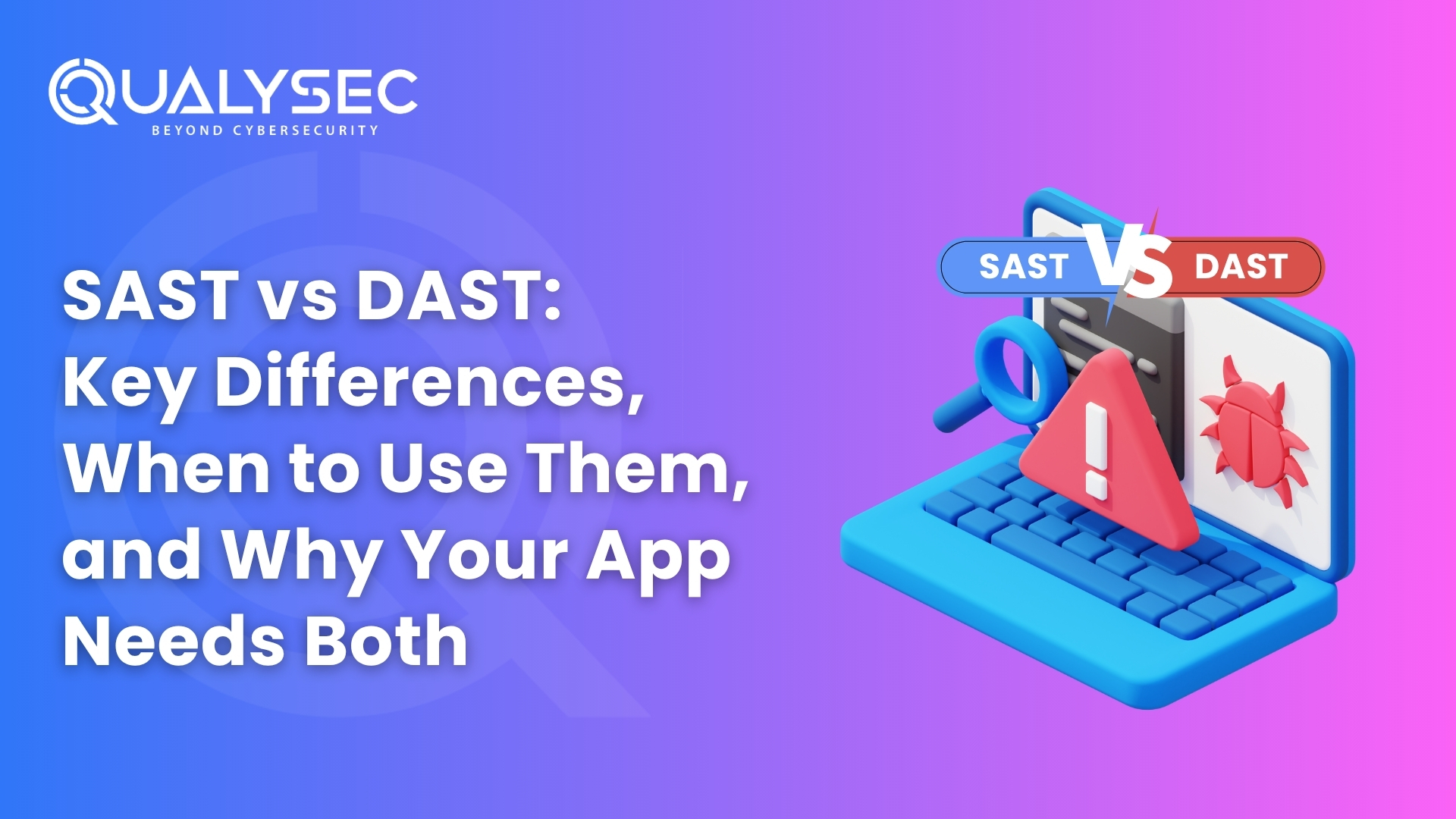
IAST Vs. Traditional Application Security Testing Tools
Most businesses already use several application security testing tools, yet each technique by itself has obvious drawbacks.
SAST (Static Application Security Testing)
- Reads source code without running the program.
- Aids early diagnosis of development cycle problems.
- Lack of runtime context generates many false positives.
- Cannot confirm if a flaw can be exploited, indeed.
DAST (Dynamic Application Security Testing)
- Testing programs viewed from an outside attacker’s standpoint
- Simulates actual attack patterns.
- Unable to observe data flow or internal code logic
- Often lacks more extensive approval or company logic faults.
IAST (Interactive Application Security Testing)
- Runs inside the application context
- Tracks actual path execution and data flow.
- Gives specific vulnerability information with context.
- Integrates seamlessly with CI/CD processes.
Many companies today use IAST solutions with other resources instead of relying just on one testing technique.
Explore Application Security in Cybersecurity to protect applications from modern cyber threats.
Comparison: IAST VS SAST VS DAST
| Feature | SAST | DAST | IAST |
| Runtime visibility | No | Partial | Yes |
| Code-level accuracy | Medium | Low | High |
| False positives | High | Medium | Low |
| Developer friendly | Medium | Low | High |
| CI CD compatibility | Yes | Limited | Yes |
| Exploit validation | No | Partial | Yes |
Get a Free Sample Pentest Report
What Kinds Of Vulnerabilities May Iast Find?
IAST security analysis finds flaws that sometimes stay unnoticed until runtime. Because it follows data flow end to end, it clearly illustrates how backend logic interacts with user input.
Commonly found weaknesses are:
- SQL injection, whereby untrusted input finds database queries
- Unsafe output handling leads to cross-site scripting (XSS)
- Command injection, above all, in backend integrations
- Insecure deserialization results in distant code execution
- Authentication faults include poor session management
- Approval bypass reveals limited features
- Sensitive data exposure, including credentials and personally identifiable information (PII)
- Unsafe API use, typical of microservices
Because of its depth, IAST security is more dependable than elementary vulnerability analysis.
Discover our recent guide on vulnerability testing.
Advantages Of Interactive Application Security Testing
- 1. Lower False Positives: IAST only identifies vulnerabilities that are actively run throughout the runtime. This lets security teams concentrate on actual dangers rather than hypothetical results and helps to cut down on alert fatigue.
- 2. Speedier Solutions: Every issue has file names, line numbers, execution paths, and repair advice. Developers can solve issues without drawn-out back-and-forth with security teams.
- 3. Great DevSecOps Fit: Naturally integrating into CI/CD workflows, IAST testing is appropriate for agile and DevSecOps setups.
- 4. Improving risk prioritization: Based on actual exploitability, problems are rated so that teams address first high-impact vulnerabilities.
- 5. Lesser Security Debt: Regular interactive application security testing stops flaws from piling up over time.
IAST offers direction and clarity for teams overburdened by noisy penetration testing results.
Discover our detailed guide on Application security best practices
Is Iast Suitable For Indian Organizations?
Certainly. For Indian businesses, IAST interactive application security testing is especially pertinent given the quick digital growth across industries.
Some main motivations include:
- SaaS, fintech, and healthtech platforms are experiencing explosive growth
- Significant dependency on cloud-native designs and APIs
- Compliance needs such as CERT-In warnings, PCI DSS, and ISO 27001
- Increasing examination of data protection and breach responsibility
Indian government-linked organizations, businesses, and startups profit from last solutions that provide correctness without stifling creativity.
Penetration Testing And IAST: Synergy
IAST complements rather than substitutes penetration testing tools. Rather, it builds it by offering constant insight throughout growth.
- Early and constantly, IAST discovers weaknesses: During development and testing cycles, problems are found.
- Manual penetration testing confirms actual assault situations: Ethical hackers represent sophisticated attacker actions.
- Together, they provide a tiered security guarantee: Across code, runtime, and business logic layers, coverage gets better.
For full application security coverage, many companies combine manual penetration testing, vulnerability scanning, and IAST security.
When Should You Use Iast?
IAST works best when:
- Applications are often corrected or actively created.
- Already established are CI/CD pipelines.
- Teams need immediate security comments.
- Accuracy comes before results count.
For web apps, APIs, and microservices where runtime behavior drives risk, it is particularly useful.
Explore Qualysec’s application security services!
How Qualysec Helps With Interactive Application Security Testing
Qualysec helps companies to deploy IAST interactive application security testing in a manner that genuinely provides value, not only reports.
Qualysec contributes the following:
- IAST security testing conducted by experts matched genuine corporate risks
- Combining IAST with manual penetration testing tools for broader coverage
- Clear vulnerability validation to get rid of false positives
- Actionable reports geared for developers, not only auditors
- Support for Indian regulatory and compliance demands
Consequently, IAST is not considered a separate checkbox. It is presented as part of a total application security plan.
How You Can Get Started
- Arrange a security review to see whether IAST matches your application stack.
- Include IAST with penetration testing for better attack simulation.
- Get developer-ready repair instructions that hasten fixes.
Talk to Qualysec about implementing IAST in your AppSec pipeline!
Speak directly with Qualysec’s certified professionals to identify vulnerabilities before attackers do.

Conclusion
Today’s application attacks use forgotten runtime behavior, actual execution paths, and hidden logical flaws. Interactive application security testing helps companies obtain the visibility they need to identify and solve these hazards before they become production-ready.
IAST security testing closes the divides created by conventional application security tools by integrating precision, context, and developer-focused insights. For Indian companies creating contemporary digital platforms, interactive application security testing is now mandatory. Long-term resilience depends on this.
FAQs
1. What is Interactive Application Security Testing (IAST)?
Interactive application security testing is a security testing strategy that detects flaws from inside applications as they run in an actual execution context.
2. How does IAST work?
Based on actual data flow, IAST integrates an agent within the application to watch runtime behavior and identify flaws.
3. What are the benefits of IAST?
Among the advantages are faster remediation, fewer false positives, developer-friendly insights, and great CI/CD compatibility.
4. How is IAST different from SAST and DAST?
While DAST tests externally, SAST examines code statically, and IAST blends runtime visibility with code-level insight.
5. What vulnerabilities can IAST detect?
SQL injection, XSS, authentication problems, hazardous deserialization, API flaws, and sensitive data exposure are all caught by IAST.
6. Is IAST suitable for all applications?
Modern web apps, APIs, and systems with active development and test coverage benefit most from IAST.













































































































































































































0 Comments