








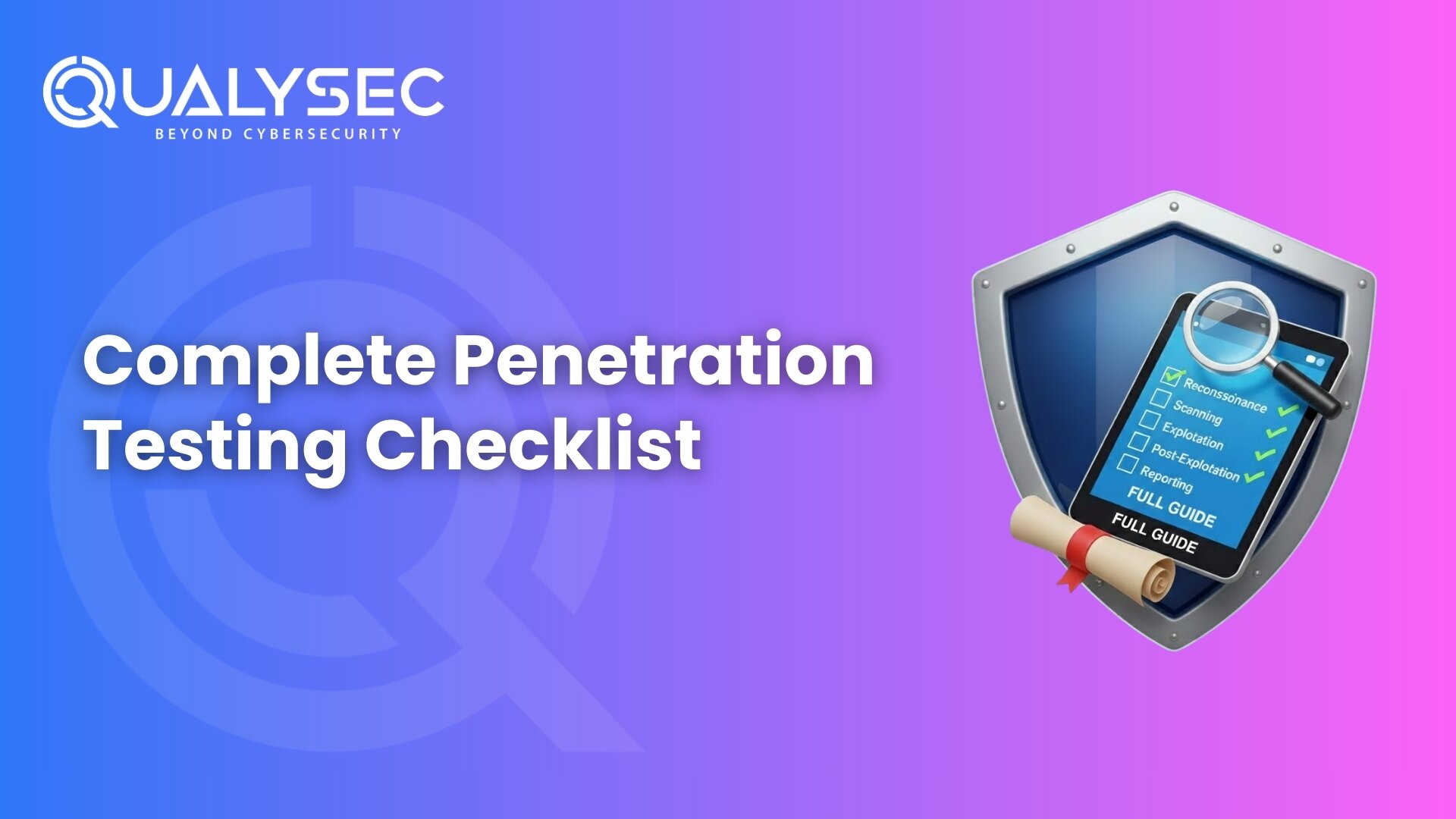
The global penetration testing market is fast expanding, creating a need for a reliable penetration testing checklist. It is projected to amount to 2.74 billion dollars in 2025 and almost 6.25 billion dollars in 2032, at an average rate of 12.5% a year. The largest share is owned by North America, approximately 36%. This demonstrates the significance of penetration tests in preventing cyber attacks in the area.
This growth is a result of an increase in cyber threats, new regulations, and a company that prefers to have improved security. For 2026, specialists indicate that penetration testing will be even more significant. This can be attributed to such new regulations as CMMC 2.0 and NIST, AI technologies to identify threats, and the necessity to secure cloud services. The companies within the U.S. should use a complete checklist that encompasses all phases of a test. The 2026 checklist is provided in this blog, which contains the key steps of the planning process and includes testing and debugging problems, using the current security testing requirements.
Secure your 2026 cybersecurity journey with Qualysec’s verified penetration testing checklist and expert team. Contact us now to begin your comprehensive defense strategy!
Introduction to Penetration Testing Checklist
An extensive penetration testing checklist covers all the essential steps from pre-engagement through post-test remediation. To reduce vulnerabilities and maximize the security posture, this checklist is a blueprint to guarantee that all crucial actions and checks are implemented. These components have to be incorporated to address changes in penetration testing phases and security testing needs –
- Pre-Engagement Pentest Steps
- Reconnaissance and Intelligence Collection
- Vulnerability Scanning and Assessment
- The Tactic of Exploitation and Gaining Access
- Post-exploitation and Persistence Testing
- Covering Tracks and Cleanup
- Reporting and Remediation of the Post-Test
Get a Free Sample Pentest Report
Pre-Engagement Pentest Steps
Get your organization ready before the penetration testing checklist begins. The stage establishes expectations, limits the measurement, outlines regulations, and enforces the law.
- Establish the scope and goals with the stakeholders.
- Name systems, networks, applications, and assets to be tested.
- Create legal authorizations and adhere to the relevant regulations.
- Decision on methods of testing, like black box, white box, or gray box.
- Delegate internal teams and external teams.
- Protocols and the path of escalation of documents.
- Gather system architecture and security controls.
- Establish a time plan and organize to reduce the business interruption.
This pentest preparation checklist will ensure coordination and responsibility, which are essential in the successful testing process and the right results.
Reconnaissance and Information Gathering
At this stage, the priority lies in gathering details of intelligence on the target environment.
- Carry out open-source intelligence(OSINT) passive reconnaissance.
- Locate network infrastructure and locate running hosts.
- List services being utilized on the target systems.
- Collect user, domain, and email data about the target.
- Determine publicly available data leakages or exposures.
- Gather system versions and patch status, and platform information.
In-depth reconnaissance guides the penetration tester to plan his/her strategy on how to identify vulnerabilities and deliver attacks.
Vulnerability Scanning and Assessment
Manual verification, used together with automated tools, can be used to detect security weaknesses in the penetration testing checklist.
- Carry out vulnerability scans using such tools as Nessus or OpenVAS.
- Tailor scans to network topology.
- Rank the vulnerabilities with Common Vulnerability Scoring System (CVSS) scores.
- False positives are removed by manually reviewing the scan results.
- High-risk vulnerabilities such as XSS, CSRF, SQL injection, etc., should be explicitly tested.
- Test cloud configurations and API security by exception.
- In scope, take into consideration social engineering vectors.
- Checking patch application and software components that are out of date.
- Validate vulnerabilities that are prioritized are the basis of future exploitation.
Exploitation and Gaining Access
It is an initial stage of penetration testing that will determine which vulnerabilities can be exploited and the consequences of intrusion.
- Make an attempt at exploitation with trusted tools and custom scripts.
- Get access to the vulnerabilities identified with minimal interference.
- Abuse network services, websites, and usernames/passwords.
- Test to see whether there is privilege escalation.
- Apply social engineering when authorized.
- The exploits and entry points used in documents.
- Network crashes or loss of data are avoided.
Effective tests identify the real-world risk, and priority-based mitigation is done on the critical vulnerabilities.
Post-Exploitation and Persistence Testing
The stages of penetration testing checklist are not limited to initial access testing, but also persistence testing.
- Keep the access between sessions in order to simulate the dwell time of attackers.
- Consider lateral mobility capability in the network.
- Determine channels of exfiltrating data.
- Check Privilege retention and reboot privilege escalation.
- Evaluate the evasion technique.
- Document persistence approaches and controls were bypassed.
It is through post-exploitation stages that attacker behaviors are forecasted to offer a holistic defense mechanism.
See How We Helped Businesses Stay Secure

Covering Tracks and Cleanup
Ethical testers clean out traces to put the systems back to the state before the tests.
- Destroys the logs or files that are made during testing (where permitted).
- Modifications in the revert configurations were made on exploitation.
- Record any artifacts and evidence that have been left behind.
- The regular operation of confirm systems after testing.
Cleanup secures the production environments, as well as avoiding test artifacts that can lead to problems.
Reporting and Post-Test Remediation
Presentation of the penetration testing checklist results should be understandable and remediable by the remediation teams.
- Give comprehensive technical vulnerability descriptions.
- Contain screenshots, evidence of implementation code, and logs.
- Identify problems according to the level of seriousness and consequences.
- Prescription of recommended remedial measures and priorities.
- Fixed the schedule for follow-up retesting.
- Have executive summaries that contain risk assessment.
- Status of compliance fulfilment of the document.
- Cover all security testing requirements agreed upon pre-engagement.
Successful reporting will simplify in a short period of threat elimination and enhance the organization’s cybersecurity.
How Qualysec Technologies Can Assist
U.S. companies can use the entire 2026 checklist with a proven and step-by-step test process with the assistance of Qualysec Technologies. Our reviews are factual and supported by data and contain all the test steps and security requirements. Our professionals perform the complete pentest checklist with great attention, and hence the clients comply with regulations and enjoy high security.
- Pre-Engagement Pentest Steps – Qualysec establishes definite scopes, approvals, and keeps the stakeholders on track. The baseline rules and notes of engagement are written in a way that makes the prep smooth.
- Carry Out Reconnaissance – We gather open-source information and map networks in a very precise way, discovering concealed threats and turning them into issues.
- Accurate Vulnerability Scanning – Qualysec runs Nessus and manual inspection, and prioritizes risks according to the CVSS score in order to concentrate on the highest threats.
- Drive Exploitation with Control – Testers exploit weaknesses safely, proving impacts without disruptions, and document every access point.
- Test Post-Exploitation Persistence – Without the system halting, the testers will exploit the weaknesses safely to demonstrate the effect, and they will also document all the pathways of the logins.
- Clean Up and Reporting – We repair any bugs and make a clear report with priority fixes and a step-by-step recovery plan.
What Sets Qualysec Apart
- Proven Testing Process – The proven process at Qualysec gives customers a chance to view all the steps. Unlike the generic forms, we customize the test to your cloud, API, and mixed environments.
- Tailored to 2026 Threats – The team is equipped with AI attack models and zero-trust checks, which align with the 2026 pentest checklist.
- Compliance Mastery – Our planned stages of testing bring clients to compliance with CMMC 2.0, NIST, and PCI-DSS.
- Remediation Support – Qualysec then takes the test again after making the fixes to demonstrate actual improvement.
- USA‑Focused Expertise – Authorized testers are aware of the U.S. regulations and provide timely and practical responses.
Qualysec is a trusted company, as customers document all decisions, tools, and results. That instills confidence and accelerates fixes. Get a custom assessment by Qualysec Technologies – today!
.
See Why Companies Worldwide Trust Us

Conclusion
Companies relying on this entire 2026 penetration testing checklist become more resistant to the increased cyber threats. Vetting each test step identifies areas of weakness, puts these areas back in line with the rules, and reduces the possibility of a break-in. Teams obtain clear guidance on how to resolve any issue and improve security. Continuous tests will be in line with AI assaults and cloud issues. Use this checklist today and be ahead of the game, secure your systems, protect your data, and be stronger. Incorporate the element of penetration testing into your 2026 cyber plan to defend against the long-term threats and continue doing business.
Qualysec’s verified penetration testing checklist provides the defense that you need to fight in 2026. Contact us now!
Speak directly with Qualysec’s certified professionals to identify vulnerabilities before attackers do.

FAQs
1. What are the phases of a penetration testing engagement?
The scoping and approvals are the beginning of the penetration testing phases. Then we collect intelligence, scan vulnerabilities, and then test the consequences of the exploitation, clean up, and lastly report on our findings. One step after another replicates an actual attack.
2. How do you prepare your organization for a penetration test?
The first phase of creating a pentest preparation checklist is outlining the scope and objectives, obtaining legal approvals, enumerating the assets under the scope, establishing rules of engagement, assigning responsibilities, collecting system baselines, and establishing communication plans. These are the steps that are designed to prevent the surprises.
3. What documentation is needed before penetration testing?
Gather the scope information, legal agreements, and non-disclosure agreements, roster of contacts, network design, base set, existing security policies, compliance rules, and procedures in the event of security breaches. This facilitates the smooth running of the test.
4. What should be included in post-test remediation?
Include every known vulnerability, severity, evidence of the exploit, the remedial actions, timelines, who will undertake the remedial action, and a retesting schedule. Currently, Items of critical importance must be prioritized, progress monitored, and the fixes made sure to seal the gaps






















































































































































































































































0 Comments