






India’s banking industry is facing renewed cybersecurity scrutiny following a series of high-profile data exposure incidents. In October 2026, State Bank of India (SBI) disclosed that its preliminary investigation had identified 3,897 customer records containing personally identifiable information among approximately 3.75 lakh records found on the dark web. Reports published on November 14 revealed that an FIR had subsequently been registered concerning an alleged compromise of the bank’s IT infrastructure.
The incidents involving SBI, Bank of Baroda and AU Small Finance Bank reveal a broader concern: Indian banking data breaches are no longer limited to core banking infrastructure. Customer information, employee identities, third-party applications and cloud-connected services are all potential sources of risk.
For banking CISOs, CTOs and risk leaders, these incidents offer practical lessons about data protection, third-party risk management and penetration testing.
Recent Banking Data Breaches in India: 2024 to 2026
Several publicly reported incidents illustrate how cyber threats affect different parts of India’s financial infrastructure.
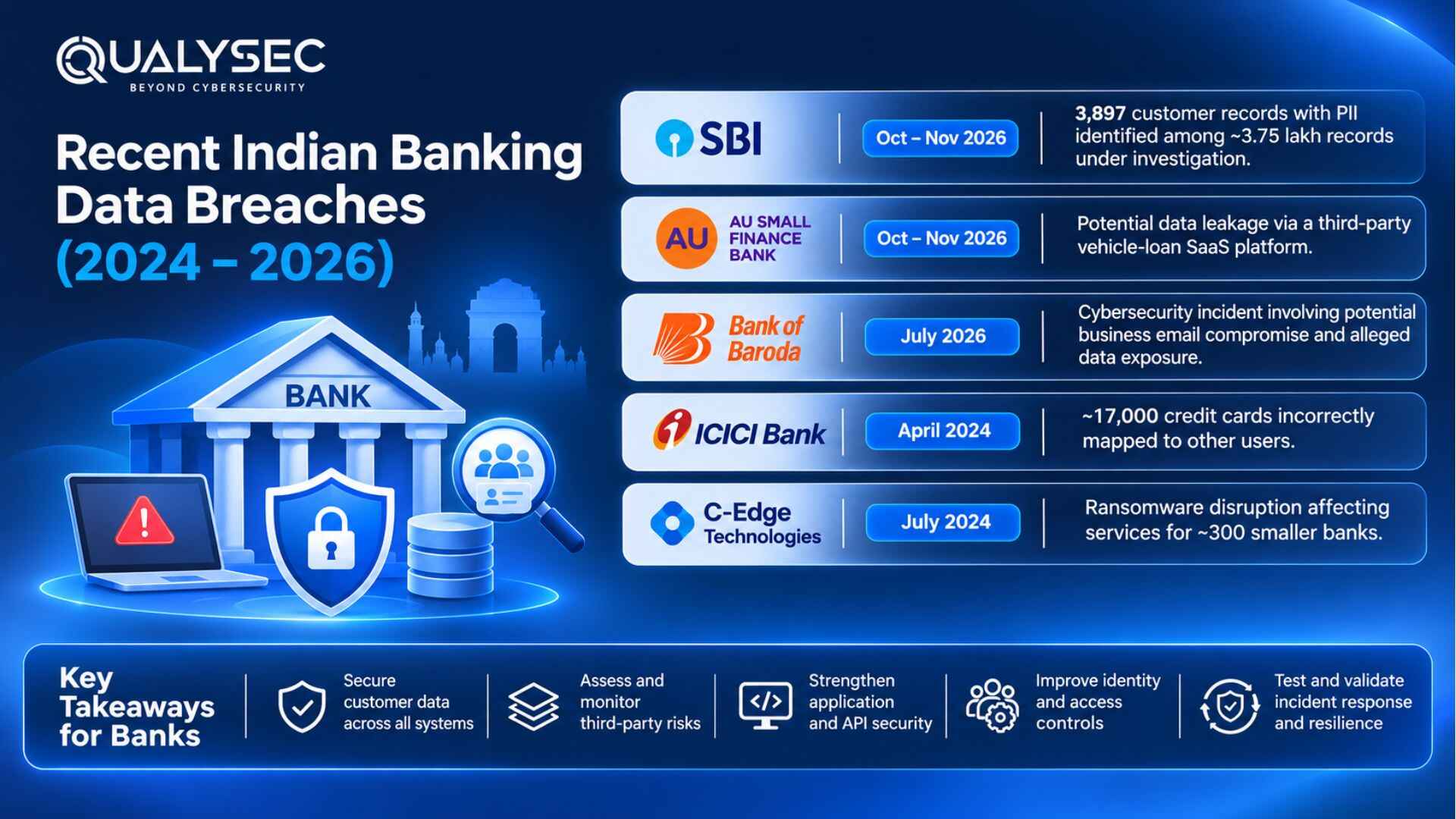
| Institution | Incident date | Reported impact |
| SBI | October–November 2026 | 3,897 PII-containing customer records identified in preliminary review; broader investigation |
| AU Small Finance Bank | October–November 2026 | Potential data leakage involving a third-party vehicle-loan SaaS platform |
| Bank of Baroda | July 2026 | Potential business email compromise and alleged data exposure |
| ICICI Bank | April 2024 | Approximately 17,000 credit cards incorrectly mapped to other users |
| C-Edge Technologies | July 2024 | Ransomware-related payment disruptions affecting nearly 300 smaller banks |
These cases represent different types of incidents. A confirmed operational disruption, an acknowledged data exposure and an unverified criminal claim should not be treated as equivalent.
1. SBI Data Breach 2026: What Happened?
On October 21, 2026, SBI disclosed an incident involving the loss of certain data after receiving alerts on October 16 from threat intelligence sources, the Defence Cyber Agency and CERT-In.
A preliminary review of approximately 375,000 records found on the dark web identified 3,897 customer records containing personally identifiable information.
The reported information included:
- Customer names and registered mobile numbers
- Email and residential addresses
- Dates of birth and gender
- Branch and Customer Information File identifiers
- Information associated with loan and lead records
SBI activated its incident response procedures and appointed an independent CERT-In-empanelled cybersecurity agency to investigate. The bank stated that customer account balances and funds were safe and that its core business operations remained unaffected.
November 2026 update: According to an Economic Times report published on November 14, an FIR was registered following allegations of unauthorised access to SBI’s Global IT Centre. The report referenced approximately 3.75 lakh records and 4,280 customer records. These figures should be attributed to the subsequent police reporting rather than presented as SBI’s original confirmed customer count.
What banks can learn from SBI
The SBI incident demonstrates why sensitive customer data requires security controls beyond transactional banking systems.
Financial institutions should assess how customer information is stored, accessed and transferred through loan management applications, internal platforms, APIs and supporting databases.
Security priority: Conduct risk-based application, API and infrastructure penetration testing while strengthening data access monitoring and incident response procedures.
2. AU Small Finance Bank: Third-Party SaaS Exposure
On November 2, 2026, AU Small Finance Bank disclosed that it was investigating potential data leakage involving a third-party Software-as-a-Service platform used for vehicle loan customer onboarding.
The bank stated that approximately 28.5 lakh vehicle-loan customers had been onboarded through the platform. This figure represents the platform’s customer population, not the number of customers confirmed to have had data exposed.
AU Small Finance Bank reported that its other systems remained unaffected and banking services continued normally.
The incident illustrates a fundamental challenge for modern financial institutions: customer data security depends partly on external technology providers.
What banks can learn
A bank may maintain strong internal security controls while still facing exposure through an outsourced application.
Third-party assurance should examine:
- Vendor authentication and authorisation controls
- Sensitive-data handling and retention
- API integrations and permissions
- Cloud configuration and access management
- Security testing and incident notification obligations
Security priority: Include critical third-party applications and integrations in the organisation’s broader risk assessment and penetration testing programme, with appropriate contractual authorisation.
3. Bank of Baroda Cybersecurity Incident: July 2026
On July 27, 2026, Bank of Baroda disclosed a cybersecurity incident involving potential business email compromise.
Reuters reported that customer information and internal documents allegedly appeared on the dark web. The dataset was advertised as exceeding 700 GB, although this advertised size should not be interpreted as independently verified stolen data.
Bank of Baroda initiated an investigation and stated that its core banking infrastructure remained secure.
What banks can learn
Business email compromise can expose sensitive communications and documents without necessarily compromising core banking applications.
Banks should prioritise:
- Phishing-resistant multifactor authentication
- Privileged access management
- Employee account monitoring
- Email security controls
- Data loss prevention
- Incident response exercises
Security priority: Assess identity infrastructure, employee-facing applications and the pathways through which compromised accounts could access sensitive information.
4. ICICI Bank: Credit Card Data Exposure in 2024
In April 2024, ICICI Bank acknowledged a technical issue that incorrectly mapped approximately 17,000 newly issued credit cards to other users.
The issue reportedly allowed some users to view another customer’s card information through the bank’s digital application.
ICICI Bank blocked affected cards and initiated replacements. The bank reported no known misuse associated with the incident at the time.
The incident shows that security exposure does not always originate from an external attacker. Application logic and data-access failures can also create serious risks.
Security priority: Test account-to-account isolation, object-level authorisation, user-session handling and the business logic governing sensitive financial information.
5. C-Edge Ransomware Attack: Nearly 300 Banks Affected
In July 2024, a ransomware incident involving banking technology provider C-Edge Technologies disrupted payment services associated with nearly 300 cooperative and regional rural banks.
NPCI temporarily disconnected C-Edge from its retail payment network as a containment measure.
Services were restored following assessment and remediation. NPCI stated that the ransomware impact was limited to C-Edge’s infrastructure rather than the banks’ own systems.
The incident highlighted the operational risks of shared service providers.
Security priority: Validate network segmentation, recovery capabilities, vendor dependencies and ransomware response procedures.
What Do These Incidents Reveal About BFSI Cybersecurity?
The five cases expose different weaknesses and risk categories across India’s banking technology environment.
Customer data exposure: Sensitive personal and loan information can be at risk even when transaction systems continue operating normally.
Third-party dependency: Outsourced applications and shared infrastructure create security obligations extending beyond bank-owned systems.
Identity compromise: Employee accounts, privileged access and email systems can become pathways to confidential information.
Application security failures: Incorrect authorisation logic and data mapping can expose sensitive records without a traditional hacking incident.
Operational resilience: Ransomware affecting a critical provider can interrupt services across multiple financial institutions.
For cybersecurity decision-makers, the central lesson is that protecting the core banking system alone does not address the entire financial institution’s attack surface.
How Can Indian Banks Prevent Data Breaches?
Preventing every cyberattack is unrealistic. However, institutions can reduce the likelihood and impact of successful breaches by continuously identifying, validating and addressing security weaknesses.
1. Conduct regular penetration testing
Assess customer-facing applications, banking APIs, internal networks, cloud infrastructure and supporting systems.
Penetration testing should identify exploitable weaknesses rather than rely exclusively on automated vulnerability scans.
2. Strengthen API and application security
Test authentication, object-level authorisation, sensitive-data exposure, transaction workflows and insecure business logic.
3. Assess third-party security risks
Review the security of outsourced applications, connected services and vendor access. Include security obligations, incident notification and remediation requirements in vendor governance.
4. Improve identity and access management
Implement phishing-resistant authentication where feasible, apply least-privilege access, review privileged accounts and monitor unusual authentication activity.
5. Validate incident response capabilities
Test the organisation’s readiness for ransomware, customer-data exposure, compromised credentials and third-party disruptions.
6. Maintain continuous vulnerability management
Prioritise security findings according to exploitability, asset criticality and business impact. Retest remediated weaknesses to confirm effective resolution.
RBI Cybersecurity Requirements and Banking Security Testing
The Reserve Bank of India issued its Commercial Banks – Cybersecurity, Technology: Risk, Resilience and Assurance Framework Directions, 2026.
The framework covers cybersecurity governance, technology risk, vulnerability assessment, penetration testing, incident response and operational resilience.
For specified critical and customer-facing systems, the directions establish minimum vulnerability assessment and penetration testing frequencies. Institutions must also consider applicable requirements relating to material system changes and other security assurance activities.
These obligations should be assessed according to each institution’s regulatory category and system scope.
Compliance is an essential baseline, but effective security also requires validating whether attackers could exploit weaknesses in real operating environments.
How Qualysec Supports Banking Security Assessments
For banks, NBFCs, fintech companies and payment technology providers, security assessments must address the interconnected systems that process sensitive financial information.
Qualysec helps organisations identify and validate security vulnerabilities through:
- Web Application Penetration Testing: Evaluate application security, access controls and sensitive-data handling.
- API Penetration Testing: Identify broken authorisation, insecure authentication and business logic weaknesses.
- Cloud Penetration Testing: Assess cloud access permissions, configurations and exposed services.
- Network Penetration Testing: Evaluate infrastructure vulnerabilities and potential attack paths.
- AI Application Penetration Testing: Assess risks affecting AI-enabled financial applications.
- Penetration Testing as a Service (PTaaS): Manage assessment findings, remediation coordination and retesting through a centralised workflow.
These assessments can support risk reduction and security assurance activities. They do not independently guarantee regulatory compliance or prevent every incident.
Is Your Banking Infrastructure Exposed to Similar Risks?
Recent Indian banking incidents demonstrate how vulnerabilities in applications, identity systems, service providers and connected infrastructure can create significant business exposure.
Work with Qualysec to identify exploitable weaknesses before they become security incidents.
Explore Qualysec’s penetration testing services or discuss a security assessment for your banking applications, APIs and infrastructure.

Frequently Asked Questions
What are the recent banking data breaches in India?
Recent incidents include SBI’s October 2026 customer-data exposure, AU Small Finance Bank’s investigation into a third-party SaaS platform, and Bank of Baroda’s July 2026 cybersecurity incident.
How many SBI customer records were exposed in 2026?
SBI’s October 2026 preliminary examination identified 3,897 customer records containing personally identifiable information among approximately 3.75 lakh records found on the dark web. Subsequent police reporting referenced additional figures, and the investigation continued.
What is the biggest cybersecurity risk for Indian banks?
There is no single universal risk. Credential compromise, insecure applications, third-party exposures, ransomware and weaknesses in access management can all create significant security consequences.
Can penetration testing help prevent banking data breaches?
Yes. Authorised penetration testing can identify exploitable weaknesses before malicious actors discover them. Its effectiveness depends on appropriate scope, timely remediation, retesting and other supporting security controls.
How often should banks conduct penetration testing?
Testing frequency should follow the applicable RBI directions, the institution’s risk profile and system criticality. The 2026 commercial-bank directions establish minimum frequencies for specified systems.
Conclusion
The SBI, AU Small Finance Bank and Bank of Baroda incidents demonstrate why banking cybersecurity needs to extend across customer data, applications, identity infrastructure and third-party services.
For financial institutions, the goal should be clear: identify security weaknesses early, validate their business impact, prioritise remediation and continuously verify security controls.
Proactive security assessment is not simply a compliance activity. It is a necessary part of protecting customer trust and digital banking resilience.