








Why Do Healthcare Organizations in the USA Need Penetration Testing?
Healthcare penetration testing is effective in dealing with special industry challenges. To begin with, medical data is retrieved 50 times compared to financial data. Thus, healthcare systems are actively attacked by cybercriminals. Moreover, hospitals contain huge amounts of sensitive data. As a result, they are the best targets of attacks.
Cybersecurity testing of healthcare averts costly breaches of data. Further, it has a mean time of 277 days to become aware of the breach. In the meantime, millions of patient records are stolen unnoticed by the attackers. Therefore, proactive testing detects threats in advance. Moreover, the prevention of infections saves businesses millions of dollars each year.
Assessment of healthcare security promotes HIPAA compliance needs. In particular, HIPAA obliges the periodic security assessment. Also, penetration testing proves due diligence. Thus, organisations will be spared the expensive compliance fines. In addition, they keep trusting the patients at all times.
Penetration testing for healthcare secures valuable patient care systems. To begin with, ransomware attacks may cause a total disruption of the work of hospitals. Also, vulnerable medical equipment poses a direct risk to patients. In addition, emergency care is influenced by downtime. Consequently, the continuity of operations is guaranteed through testing.
Key Reasons for Testing:
- Stolen medical data sells for premium prices
- Average breach costs exceed $10 million
- HIPAA requires regular security evaluations
- Ransomware attacks disrupt patient care
- Legacy medical systems contain vulnerabilities
- Third-party vendors expand attack surfaces
Schedule a free consultation with Qualysec to discuss your security needs now.
Core Elements of a Healthcare Security Evaluation
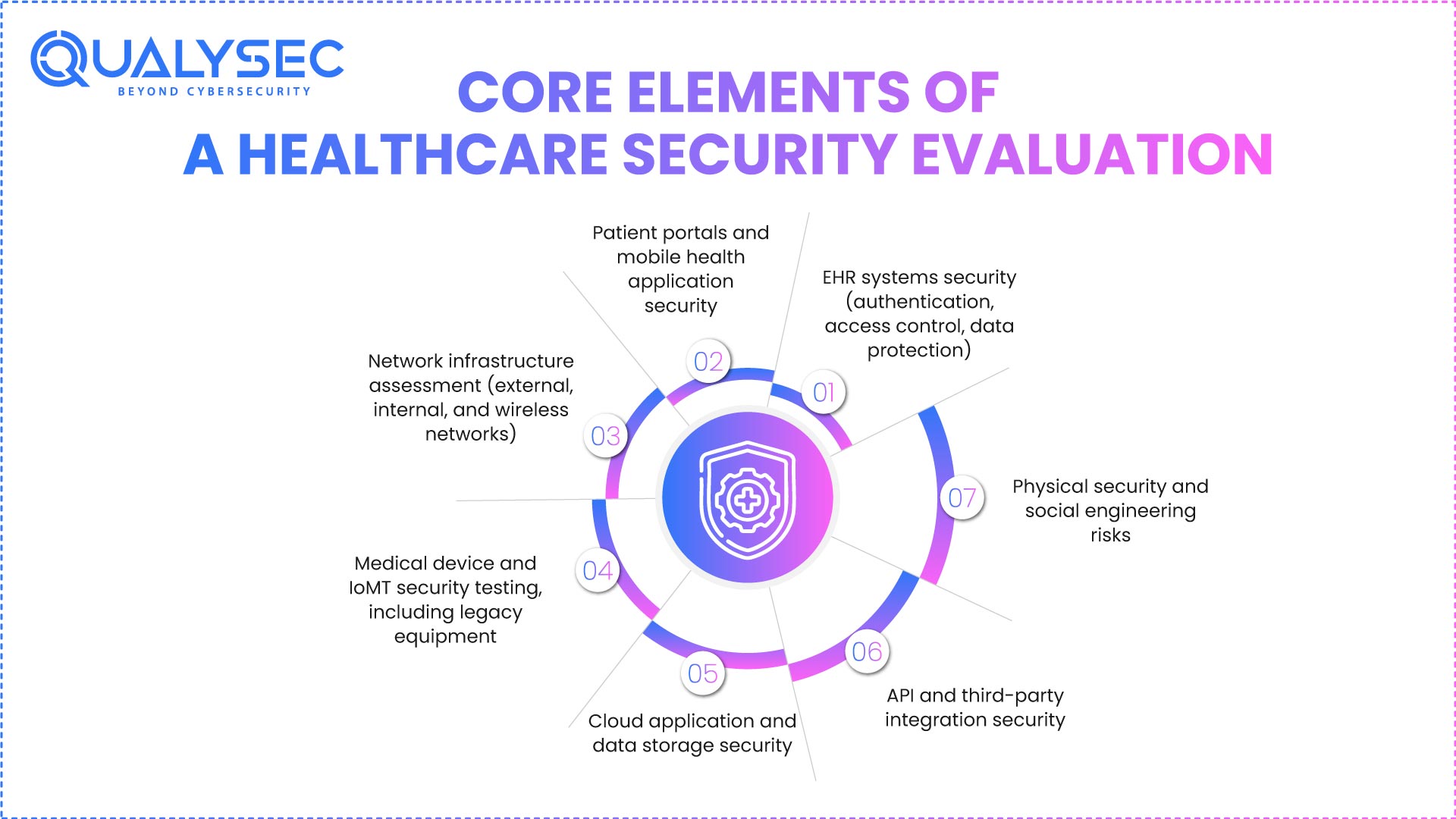
Healthcare security testing reviews various critical aspects. To start with, testers test electronic health record systems comprehensively. As well, they evaluate the security of patient portals in totality. In addition, mobile health apps are checked by medical application penetration testing. In this way, any access points to patient data are examined.
Network infrastructure assessments are a part of the PHI security assessment. First, the testers scan external networks in search of vulnerabilities. After that, they investigate the security of the inner network attentively. Besides, they test wireless network protection in particular. As a result, organisations will be aware of their entire attack surface.
Medical device security is assessed under healthcare penetration testing. To begin with, the Internet of Medical Things (IoMT) devices have to be tested. Also, there are infusion pumps and monitors which should be evaluated. Additionally, the medical equipment that is very old tends to have gaps. Hence, dedicated testing is safe for patients.
Cybersecurity testing undertaken in healthcare focuses on how well third-party integrations are tested. The first step to be taken is to verify the security ofthe vendor portal by testers. Then, they consider API authentication systems. They later test data sharing protocols. Last, they ensure compliance of business associates.
Read: Medical Device Cybersecurity: The Importance In Healthcare
Testing Components Include:
- EHR Systems: Authentication, access controls, data protection
- Patient Portals: Login security, session management, data exposure
- Medical Devices: Firmware security, network connectivity, default credentials
- Cloud Applications: Configuration, access management, data segregation
- APIs: Authorisation, data exposure, endpoint discovery
- Physical Security: Badge systems, tailgating risks, social engineering
Explore our comprehensive service overview for detailed testing methodologies.
HIPAA Compliance: How Penetration Testing Helps
Healthcare penetration testing promotes compliance with the HIPAA Security Rule directly. In particular, HIPAA mandates the routine risk analysis. Further, penetration testing assures the effectiveness of security controls. As such, organisations show compliance on the proactive level. Further, testing offers audit-ready documentation.
HIPAA technical safeguards are covered by a healthcare security assessment. The first is that §164.308(a)(1)(ii)(A) entails the identification of threats to ePHI. Also, §164.308(a)(8) requires security assessments on a regular basis. Also, the penetration testing for healthcare meets such requirements. Consequently, organisations are in constant compliance.
PHI security assessment gives evidence of risk management. First, testing determines possible weaknesses systematically. Subsequent to this, organisations put security measures in place. Further, retesting ensures that there are no fixes to be made. As a result, health practitioners are shown to comply constantly.
The healthcare cybersecurity testing assists organisations in preventing fines. In particular, the privacy breaches under HIPAA incur up to one and a half million dollars a year. On top of that, the requirements of breach notifications impose operational costs. Moreover, non-compliance detracts company’s image tremendously. Thus, frequent testing averts expensive offences.
HIPAA Requirements Addressed:
- Risk Analysis (§164.308(a)(1)(ii)(A)): Identifying ePHI threats
- Risk Management (§164.308(a)(1)(ii)(B)): Implementing security measures
- Security Evaluation (§164.308(a)(8)): Regular testing and monitoring
- Access Control (§164.312(a)(1)): Validating authorization mechanisms
- Transmission Security (§164.312(e)(1)): Testing encryption effectiveness
Get your free HIPAA compliance assessment from Qualysec today.
Common Vulnerabilities Found in US Healthcare Systems
The important vulnerabilities are often found during healthcare penetration testing. To start with, old medical equipment is based on old operating systems. Moreover, 73 per cent of providers have outdated software on equipment. In addition, these devices cannot be updated in terms of security. Thus, they are always at risk of attack.
Authentication weaknesses are discovered frequently during medical application penetration testing. First, password policies are weak, and easy access can be gained. Next, the absence of multi-factor authentication is dangerous. Moreover, broken session management makes it possible to gain unauthorised access. As a result, hackers steal the patient information with ease.
Network segmentation failures are often diagnosed as a result of healthcare security testing. To begin with, medical equipment uses the same WiFi network as the guest WiFi. Also, the isolation of systems is not properly done. In addition, it makes lateral movement trivial. Therefore, ransomware travels quickly on networks.
The API security issues are common with PHI security assessments. The first step is the unbroken authorization which enables access to data. Then, information is lost through information overexposure. Also, unauthorised terminals are not secured. Consequently, the attackers take advantage of API vulnerabilities.
Learn about The Importance of Healthcare Data Security: Challenges and Best Practices
Common Security Issues:
- Unpatched Systems: Critical vulnerabilities remain unfixed for months
- Weak Credentials: Default passwords on medical equipment
- Missing Encryption: Patient data transmitted without protection
- Poor Access Controls: Excessive user privileges granted unnecessarily
- Vendor Vulnerabilities: Third-party systems lack security oversight
- Cloud Misconfigurations: Improperly configured storage exposes data
| Vulnerability Type | Impact | Remediation Priority |
| Unpatched EHR | Data breach risk | Critical |
| Weak Authentication | Unauthorized access | High |
| Network Misconfiguration | Lateral movement | Critical |
| Medical Device Flaw | Patient safety risk | Critical |
| API Vulnerability | Data exfiltration | High |
How to Choose the Right Healthcare Penetration Testing Company in the USA?
Healthcare penetration testing demands expert skills. In the first instance, select companies that have experience in healthcare. Also, ensure they are well conversant with HIPAA requirements. Besides, verify the existence of applicable security certifications. Thus, you guarantee good testing services.
Penetration testing for healthcare requires the services of qualified professionals. First, testers are supposed to be OSCP or CEH certified. Thereafter, confirm CREST registration to access higher functions. Moreover, job-related qualifications indicate expertise in healthcare. Therefore, the certified testers are more effective.
Cybersecurity testing companies within the sphere of healthcare are required to enter into a Business Associate Agreement. Particularly, BAAs provide HIPAA compliance in tests. Moreover, they create legal liability. Also, qualified providers willingly sign BAAs. In this way, compliance protection is preserved in your organisation.
The providers of healthcare security assessment are expected to provide comprehensive services. To begin with, they should put all healthcare systems to the test. They are also supposed to offer comprehensive remedial advice. Moreover, the unlimited retesting proves that the fixes are effective. Consequently, you attain absolute security validation.
Selection Criteria:
- Healthcare Experience: Proven track record with medical organisations
- Certifications: OSCP, CEH, CREST, CISSP credentials
- HIPAA Knowledge: Understanding of healthcare compliance requirements
- BAA Signing: Willingness to execute Business Associate Agreements
- Testing Methodology: Comprehensive approach covering all systems
- Reporting Quality: Detailed findings with remediation guidance
Compare penetration testing providers to find your perfect security partner.
Why Is Qualysec the Best Healthcare Penetration Testing Partner in the USA?
Qualysec provides incomparable value through healthcare penetration testing. To start with, Qualysec also deals only with healthcare security. Moreover, they have a zero-breach record. In addition, their team is elite certified, such as OSCP. Thus, you are provided with the best testing.
Qualysec is an amalgamation of automated scan and manual skills. First, automated vulnerabilities are fast to detect. Complex security gaps are then identified by expert testers. Moreover, such a hybrid model guarantees full coverage. Therefore, none of the vulnerabilities can go unnoticed.
Qualysec healthcare penetration testing has an unlimited retesting provision. In particular, they check all remediation activities. Also, retesting makes sure that vulnerabilities have been corrected adequately. In addition, this guarantees full security authentication. So that you obtain protection indeed, as long as possible.
Qualysec has superior support for healthcare cybersecurity testing. To start with, the testing is initiated in 3-5 business days. Moreover, there is a 24/7 emergency response that is available at all times. Moreover, some special professionals will assist you. Consequently, you have a smooth security testing.
Qualysec Advantages:
- Zero-Breach Record: No client has suffered post-testing breaches
- Elite Certifications: OSCP, CEH, CREST certified professionals
- Comprehensive Testing: Web apps, mobile apps, APIs, networks, cloud, IoMT
- Compliance Support: Audit-ready documentation for HIPAA, HITRUST, SOC 2
- Unlimited Retesting: Verify fixes work properly at no extra cost
- Rapid Deployment: Testing starts within 3-5 business days
- 24/7 Support: Emergency response available anytime
- Transparent Pricing: Clear, competitive rates with no hidden fees
Services Offered:
- Complete HIPAA risk assessment for all healthcare systems
- Web application penetration testing for EHR platforms
- Mobile application security testing for healthcare apps
- Network penetration testing (internal and external)
- Cloud security assessments for AWS, Azure, and GCP
- API security testing for healthcare integrations
- IoT medical device security testing
- HIPAA compliance audit support and documentation
Location: USA with global service delivery
Why Choose Qualysec: Over 450 successful security assessments completed. 98% customer satisfaction rate is maintained consistently. Recognised as the leading HIPAA penetration testing provider.
Start a free consultation with Qualysec now or call +1 315 675 1823.








































































































0 Comments