






TL;DR: EU IVDR Cybersecurity
- The EU IVDR (Regulation (EU) 2017/746) treats cybersecurity as a patient-safety issue.
- Annex I, Sections 16.2 and 16.4 cover software information security and minimum IT security requirements.
- Notified bodies use MDCG 2019-16 rev. 1 as their reference. Class D legacy devices have until 31 December 2027, and Class C until 31 December 2028.
Cybersecurity sounds like an IT problem until you picture a lab result being changed on its way to the patient record. Then it becomes a patient safety problem, and that’s how the EU IVDR, Regulation (EU) 2017/746, treats it. The rules are spread across Annex I, and many manufacturers only notice the gaps when a notified body asks for security evidence they haven’t produced.
Time matters here. The Class C deadlines have passed (26 May 2026 for the application and 26 September 2026 for the written agreement). Class D devices have until 31 December 2027. The Commission has also proposed changes, which are still working their way through Parliament and Council. This guide covers where security sits in the regulation, what IVDR compliance reviewers ask for, and what UK manufacturers need to watch.
The IVDR replaced a light-touch directive with a full regulatory regime. It introduced risk classes, notified bodies, performance evaluation, Eudamed, and stricter post-market duties. Many manufacturers only realise what this means when a reviewer asks for evidence they haven’t produced.
This guide covers the regulation as a whole before going deeper into cybersecurity, the part most teams underestimate. It also covers UK manufacturers and the Commission’s proposed revision, with all EU IVDR dates current through late October 2026.
Not sure your software even counts as an IVD, or what class it is? Talk to Qualysec’s team before you lock in a certification plan.
What Is the EU IVDR Regulation and Who Does It Cover?
If your product looks at a specimen from the human body and reports something about it, assume the EU IVDR regulation covers you. Reagents, analysers, and instruments are in. Software is in too, and that part matters most here. The text names software or a system outright, so a standalone algorithm can be an IVD without any hardware.
Under the IVDR regulation, Article 2 defines an IVD broadly. It covers devices used on specimens from the human body, including blood and tissue donations. They give information about a health state, a predisposition, compatibility with a recipient, or likely response to treatment. Companion diagnostics are included, and specimen receptacles count as IVDs too.
The IVDR regulation replaced the old In Vitro Diagnostic Devices Directive (98/79/EC) on 26 May 2022, its date of application. The change in style is big. Under the directive, most manufacturers could self-declare. Now only non-sterile Class A manufacturers can.
Several parties carry duties:
- Manufacturers, wherever they’re based.
- Authorised representatives, which manufacturers outside the EU must appoint.
- Importers and distributors, who check what they supply.
- Health institutions that make devices in-house, who get a limited exemption under Article 5(5) if they meet its conditions. MDCG 2023-1 explains them.
The regulation applies across EU member states and in Northern Ireland. Great Britain does its own thing, and the UK section below covers it.
Which Dates Matter for IVDR Compliance?
Devices certified under the old directive got extra time. The EU IVDR deadlines below come from Regulation (EU) 2024/1860, published and in force since 9 July 2024. The HPRA’s summary and the Commission’s transitional provisions page list them.
| Class | Application to Notified Body | Written Agreement Signed | Legacy Device Deadline |
|---|---|---|---|
| D | 26 May 2025 | 26 September 2025 | 31 December 2027 |
| C | 26 May 2026 | 26 September 2026 | 31 December 2028 |
| B and A sterile | 26 May 2027 | 26 September 2027 | 31 December 2029 |
Dates alone don’t qualify you. The device must keep complying with the old directive, with no significant change to its design or intended purpose. Your quality management system under Article 10(8) also had to be running by 26 May 2025. If you missed an interim date, talk to your notified body now, not next quarter.
How Does the IVDR Classify Your Device?
Annex VIII sets seven classification rules, and they sort every IVD into Class A, B, C or D. Risk to the patient and public health drives the class, and the class decides how involved a notified body gets.
| Class | Risk Level | Typical Examples | Route to Market |
|---|---|---|---|
| A | Lowest | Specimen receptacles, general laboratory reagents and instruments | Self-declaration; a notified body only for sterile devices |
| B | Moderate | Devices that fit no other rule, controls without assigned values, and some self-tests such as pregnancy tests | Notified body |
| C | High | Companion diagnostics, genetic tests, cancer screening and staging, sexually transmitted infections, most self-tests | Notified body |
| D | Highest | Tests that screen donations for transmissible agents, and ABO, Rhesus, Kell, Kidd and Duffy blood grouping | Notified body, plus EU reference laboratory testing where one is designated |
Software follows its own logic. Section 1.4 of Annex VIII says software that drives or influences a device takes the class of that device. Independent software gets classified in its own right under the rules. Among the EU IVDR guidelines on software, MDCG 2019-11 rev. 1 covers qualification and classification. It came out in June 2025. Read it before you decide whether your product is an IVD at all.
Do You Need a Notified Body?
For almost every IVD, yes. Under the IVDR regulation, only non-sterile Class A manufacturers can declare conformity themselves. Everyone else picks a notified body and a route under Article 48. Sterile Class A devices need one too, for the sterile aspects.
- Annex IX reviews your quality management system and your technical documentation. It works for every class that needs a notified body. For Class B and C, the reviewer samples the technical documentation.
- Annex X and Annex XI pair up as the other route for Class C and D. A type examination comes first, then production quality assurance.
- Class D adds EU reference laboratories. Where one is designated, the notified body requests verification testing under Article 48(5).
Notified bodies were slow to get designated, so sign a written agreement early and expect reviewers to ask about cybersecurity. Qualysec’s CE marking guide for medical devices covers the wider route.
What Do Performance Evaluation, Technical Documentation and the QMS Involve?
Here we take you through everything needed about the performance evaluation, technical documentation and quality management systems.
- Performance evaluation – Article 56 and Annex XIII define three key components to include under performance evaluation. These are scientific validity, analytical performance, and clinical performance. You’ll also need to update this regularly once launched, keeping up to date with ‘performance follow-up’.
- Technical documentation – There are lots of elements to include here depending upon your devices, including Annex II and Annex III covering what needs to go inside the technical documentation file. Here you need to provide a device description, details around design and manufacturing, risk analysis, verification and validation records, plus much more.
- Quality Management System (QMS) – Article 10(8) states that you need to have a quality management system that encompasses risk management, performance evaluation, and post-market activities. Finally, ensure you have designated a ‘person responsible for regulatory compliance’.
- Person responsible for regulatory compliance. Article 15 makes this role mandatory. Micro and small companies may outsource it.
What Do UDI, Eudamed and Economic Operators Add?
Every device carries a unique device identifier (UDI) under Article 24, and it has to appear on the label. Eudamed, the EU’s database, holds the registrations behind it.
Eudamed is no longer optional. Four modules became mandatory on 28 May 2026: actor registration, UDI and device registration, notified bodies and certificates, and market surveillance. Two deadlines follow, per the HPRA and Osborne Clarke:
- 28 November 2026: legacy devices placed on the market before 28 May 2026 must be registered in the UDI and device module.
- 28 May 2027: certificates issued before 28 May 2026 must be registered.
Devices launched after 28 May 2026 get no grace period. The post-market surveillance, vigilance, and performance study modules aren’t mandatory yet.

What Does the IVDR Ask for After Launch?
Article 78 and Annex III require a post-market surveillance system. How you report depends on class. Under Article 80, Class A and B manufacturers prepare a post-market surveillance report. Under Article 81, Class C and D manufacturers update a periodic safety update report (PSUR) at least annually.
Serious incidents run on a clock under Article 82:
- 15 days after you become aware of a serious incident.
- 10 days for a death or an unanticipated serious deterioration in health.
- 2 days for a serious public health threat.
A tampered result that reaches a patient record is a vigilance question, not only an IT one.
Where Do the IVDR Requirements Cover Cybersecurity?
It’s also important to understand when healthcare cybersecurity becomes a matter of patient safety and which regulations apply. For example, if there was a lab test performed incorrectly because someone had hacked into the results before sending them over to your EHR systems, this would be considered a matter of patient safety. This is also how the regulation considers it.
Annex I of the IVDR includes some general safety and performance requirements as well, but reviewers will look at these alongside all other provisions. Specifically, the Medical Device Coordination Group (MDCG) has mapped how each provision fits into this overall framework within MDCG 2019-16 rev. 1.
The Medical Device Coordination Group (MDCG) mapped how they fit together in MDCG 2019-16 rev. 1.
The table below follows that map.
| Annex I Section | What It Asks | Evidence a Reviewer Expects |
|---|---|---|
| 1 to 4, 8 | Safe performance, risk reduction, a risk management system, control measures | Risk file that treats security threats as hazards to patient safety |
| 13.1, 13.2(d), 13.5 | Safe connection to other devices, interaction with software and the IT environment, interoperability | Interface specifications, network architecture, compatibility testing |
| 16.1 | Repeatability, reliability and performance, with means to handle a single fault | Fault analysis that includes a compromised component |
| 16.2 | Software developed to the state of the art, including life cycle, risk management, information security, verification and validation | Secure development records and test reports |
| 16.4 | Minimum hardware, IT network and IT security requirements | Documented minimum security environment for the customer |
| 20.1(g), 20.2(m), 20.4.1(ah) | Residual risk and IT requirements passed on to users | Labelling and instructions for use that state your security assumptions |
Section 16.2 carries the most weight. “State of the art” lets a reviewer ask what the industry normally does today. “We followed our usual process” won’t survive that question if your usual process skips threat modelling.
Section 16.4 in Practice: Analyser-to-LIS Connection
Section 16.4 asks you to specify minimum IT and network security baselines. Relying on default local network settings won’t do.
- Weak (unacceptable): An analyser sends unencrypted HL7 or ASTM diagnostic results over standard TCP/IP to a laboratory information system (LIS). It assumes the hospital’s internal network is completely secure.
- Stronger (meets 16.4): The analyser enforces TLS 1.3 on every LIS interface and uses mutual certificate authentication (mTLS) with the LIS. The instructions for use spell out the network isolation and cipher requirements.
Want the same check on your own interfaces? Book a readiness review with Qualysec!
MDR and IVDR Regulations: What Is the Same and What Differs?
If you already hold MDR certificates, you’ll be tempted to copy the cybersecurity file across. Much of it will carry over, since MDCG 2019-16 covers both regulations in one document. But the section numbers change, and a couple of provisions don’t line up at all.
| Topic | MDR | IVDR |
|---|---|---|
| Software state-of-the-art requirement | Annex I 17.2 | Annex I 16.2 |
| Minimum IT requirements | Annex I 17.4 | Annex I 16.4 |
| Connection of devices | Annex I 14.1 | Annex I 13.1 |
| Unauthorised access provision | Annex I 18.8 | No equivalent in MDCG’s mapping |
| Classification | Classes I, IIa, IIb, III | Classes A, B, C, D |
| Software classification | Rule 11 | Software takes the class of the device it drives, or is classified on its own under Annex VIII |
Watch the last row. IVDR classification follows the specimen and the analyte. You can’t borrow the clinical-impact logic behind MDR Rule 11 and hope it fits.
Which IVDR Guidelines Apply to Cybersecurity?
Start with MDCG 2019-16 rev. 1. The first version appeared in December 2019, and the revision followed in July 2020. Qualysec’s MDCG cybersecurity guidance explainer walks through it. One useful idea in it is the “product security context.” All that means is describing where the device will live. How secure is the room? What firewall sits in front of its interfaces?
The guidance names the software bill of materials (SBOM) as one thing manufacturers often share. MDCG prefers the phrase “joint responsibility.” Notified bodies use it as their yardstick. Copy its structure in your file, and you’ll save time.
What Does IVDR Compliance Look Like for Software and Devices?
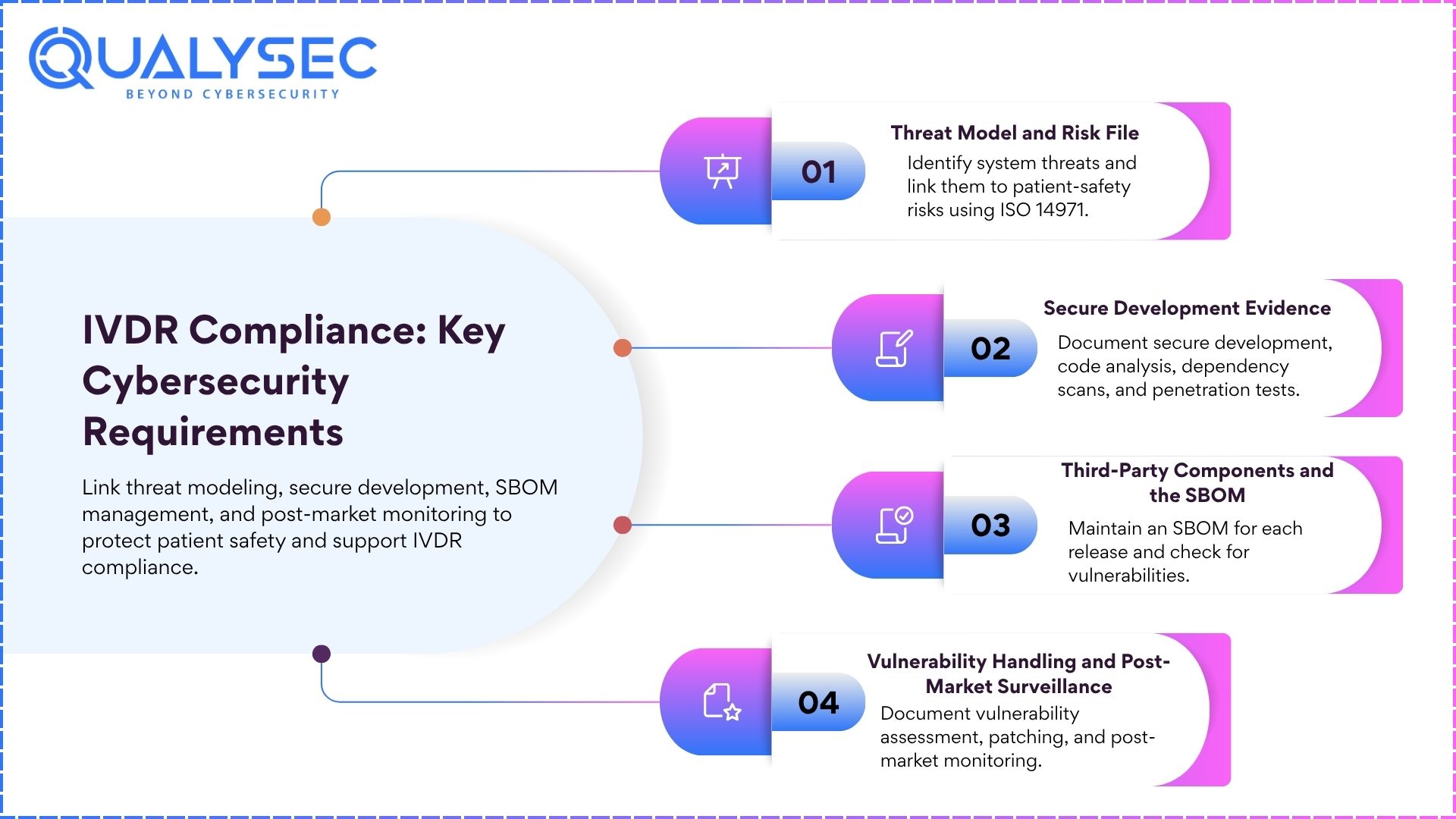
A reviewer wants one trail they can follow: threat, control, test, then post-release monitoring. If it breaks anywhere, expect questions.
Threat Model and Risk File
Model the whole system. That means the analyser, its link to the lab information system, any cloud service, and the update channel. Then tie each security threat to a patient-safety hazard in your ISO 14971 file. Skip that, and the reviewer gets two documents and has to join them up alone.
Secure Development Evidence
Section 16.2 asks for development to the state of the art, and IEC 62304 is the usual answer for the software life cycle. It says very little about security. Some teams close that gap with IEC 81001-5-1. Whichever approach you pick, keep the records. Design review minutes, static analysis reports, dependency scans, pen test results.
Third-Party Components and the SBOM
Your product almost certainly runs on code you didn’t write. An operating system, open-source libraries, a vendor driver. Keep an SBOM for every release and check it against known vulnerabilities on a schedule. Reviewers want proof that you know what you’re shipping.
Vulnerability Handling and Post-Market Surveillance
A plan that just says “we’ll monitor” is no plan. Yours needs names and steps. How do you weigh a vulnerability against patient safety? How does a patch reach devices already installed? Log every case, even the ones you close as not exploitable. Those entries show how you reasoned.
Gaps That Slow a Review
Four documentation gaps keep turning up in security files for diagnostic products.
| Gap | Why It Slows a Review | Fix |
|---|---|---|
| Threat model sits in a separate document | The risk file never cites it, so the reviewer can’t trace threats to hazards | Reference each threat in the ISO 14971 file |
| Instructions for use omit minimum IT requirements | Section 16.4 asks the manufacturer to state them | Add the hardware, network and security baseline to the labelling |
| Component inventory dates from version one | Nobody can show what the current release contains | Regenerate the SBOM with every release |
| Post-market plan says only “monitor vulnerabilities” | No owner, frequency or patch trigger | Name the owner, the review cycle and the decision criteria |
Each takes an afternoon to fix before submission and weeks to untangle during a review.
What Does the UK Market Require Under the EU IVDR Regulation?
Two markets, one flag, different rules. UK government guidance sets out the position.
- Great Britain: a CE-marked IVD that meets the old directive can stay on the market until its certificate expires or 30 June 2030, whichever comes first. IVDs that meet the IVDR can be placed on the market until 30 June.
- A recent change: On 21 October 2026, the government confirmed it intends to recognise EU MDR and IVDR certified devices indefinitely, as reported by CMS and LexisNexis. The law has to change first, subject to parliamentary approval before 30 June 2028. Until then, the existing deadlines apply.
- Northern Ireland: The regulation has applied here since 26 May 2022, so CE marking is a must.
- UKCA: Don’t count on it outside Great Britain. The EU, the EEA and Northern Ireland don’t recognise it, and UK approved bodies can’t assess conformity for CE marking either.
UK post-market surveillance rules also came into force on 16 June 2025. If you sell in both markets, you need an EU notified body for the CE route and a surveillance process that satisfies both rulebooks.
What Might Change Under the EU IVDR Revision?
On 16 December 2025, the Commission proposed simplifying the MDR and IVDR regulations. According to Simmons & Simmons, the proposal includes:
- clearer cybersecurity requirements and mandatory incident notification;
- alignment with the Cyber Resilience Act;
- certificates that can last longer than five years;
- simpler software classification, with software Class I by default under the MDR unless it informs or drives clinical management in serious or critical situations.
It would amend the regulation without replacing it. Treat it as a proposal for now. Sidley’s October 2026 update says Parliament’s rapporteur published a draft report in June 2026, and nearly 800 amendments followed. A committee vote is expected in early 2027. The Council is still examining the text, and trilogues aren’t expected before the first half of 2027. A final text looks unlikely before late 2027 or early 2028. None of this changes what you owe today.
Quick note on scope: the Cyber Resilience Act doesn’t cover products that fall under the IVDR. Article 2(2) of the CRA excludes them by name. Your cybersecurity duties as an IVD manufacturer come from the IVDR alone.
A Practical Roadmap for IVD Manufacturers
Here’s the order we’d work in for IVDR compliance:
- Confirm your product is an IVD, and settle its class under Annex VIII.
- Check your transition status with your notified body.
- Get a written agreement with a notified body, if you don’t have one.
- Build the performance evaluation and the technical file together.
- Add the security trail: threat model, secure development records, SBOM, test reports.
- Register actors, devices, and certificates in Eudamed.
- Set up post-market surveillance, vigilance and the PSUR cycle, with named owners.
How Qualysec Supports Your EU IVDR Regulation Readiness
Qualysec isn’t a notified body, and it can’t certify a device. Its job is to produce the security evidence a notified body will accept.
Medical Device Credentials
Qualysec is CREST-accredited and ISO 27001 certified. Qualysec reports 3,700+ assessments, 520+ clients and 43+ countries served. It has also launched Medysec, a subsidiary that works only on MedTech security.
Threat Modelling and Interface Testing
Qualysec models threats against your analyser, its software, and every service it talks to. Then it tests what the model points at: firmware, protocols, hardware interfaces and cloud links. You choose the depth. Black box tests what an outsider sees. White box gives testers your firmware, APIs, and source code. Grey box sits in between. Every result maps back onto your risk file.
SBOM Review and Retest Evidence
Qualysec checks your component inventory against known vulnerabilities and tests whether your process catches new ones after release. Findings arrive with technical proof, business impact and fix guidance. Once your team has fixed them, Qualysec retests and records the results with dates. Those reports drop into the technical file without rework.

Conclusion: Where to Start With the EU IVDR Regulation
The IVDR comes down to one documented argument. Work out your class and transition date, and list your markets. Then add the security trail from the Annex I table above. The December 2025 proposal could shuffle details, but secure, documented software will almost certainly stay.
Book a readiness review with Qualysec for a gap list mapped to Annex I
Frequently Asked Questions (FAQs)
1. What are the IVDR requirements for cybersecurity?
Most of what the rules ask for on cybersecurity sits in Annex I. Section 16.2 is the big one: your software has to be built to the state of the art, and that includes information security. Section 16.4 goes a step further by requiring you to specify minimum hardware, IT network and IT security measures, including protection against unauthorised access.
2. Which EU IVDR guidelines apply to cybersecurity?
MDCG 2019-16 rev. 1. It covers both regulations, and notified bodies treat it as their go-to reference.
3. How do the MDR and IVDR regulations differ on cybersecurity?
Barely, and mostly in the numbering. What the MDR calls 17.2 and 17.4, the IVDR calls 16.2 and 16.4. The MDR also has an unauthorised access provision in 18.8, which MDCG’s mapping doesn’t pair with an IVDR section.
4. Does the IVDR apply to UK manufacturers?
It applies if you place devices on the EU or Northern Ireland markets. For Great Britain, CE-marked IVDR devices are accepted until 30 June 2030, and the government has said it intends to recognise them indefinitely once the law changes.
5. When must IVDs comply with the IVDR?
It depends on class: 31 December 2027 for D, 2028 for C and 2029 for B and A sterile. That’s only for legacy devices that met the conditions in Regulation (EU) 2024/1860. New devices need IVDR certification now.
6. Does the Cyber Resilience Act cover IVDs?
No. Products covered by the IVDR sit outside it. The Commission’s December 2025 proposal aims to align the two regimes.
7. Is Eudamed registration mandatory?
Yes, for four modules since 28 May 2026. Legacy devices must be registered by 28 November 2026, and older certificates by 28 May 2027.